

The world economy in 2026 is not moving in a straight line. Tariffs, armed conflicts, and supply chain disruptions have forced companies to rethink their strategies with a speed that no business school could have anticipated. And yet, against all odds, nearly half of global professionals expect their businesses to grow this year.
The latest global study published by the Gedeth Research Center in collaboration with DHL Express and Universidade Europeia. Based on responses gathered from more than 50,000 professionals across 90 countries during Q1 2026, it is one of the most comprehensive surveys of business sentiment ever conducted in real time — capturing both pre- and post-conflict perspectives following the outbreak of the Iran-U.S.-Israel war in late February.
The numbers tell a story of pragmatic resilience, strategic adaptation, and a growing divergence between how small and large companies are responding to a world that no longer plays by the old rules.
A Tale of Two Business Sizes
Perhaps the most striking result of the study is the performance gap between SMEs and large corporations when it comes to growth expectations.
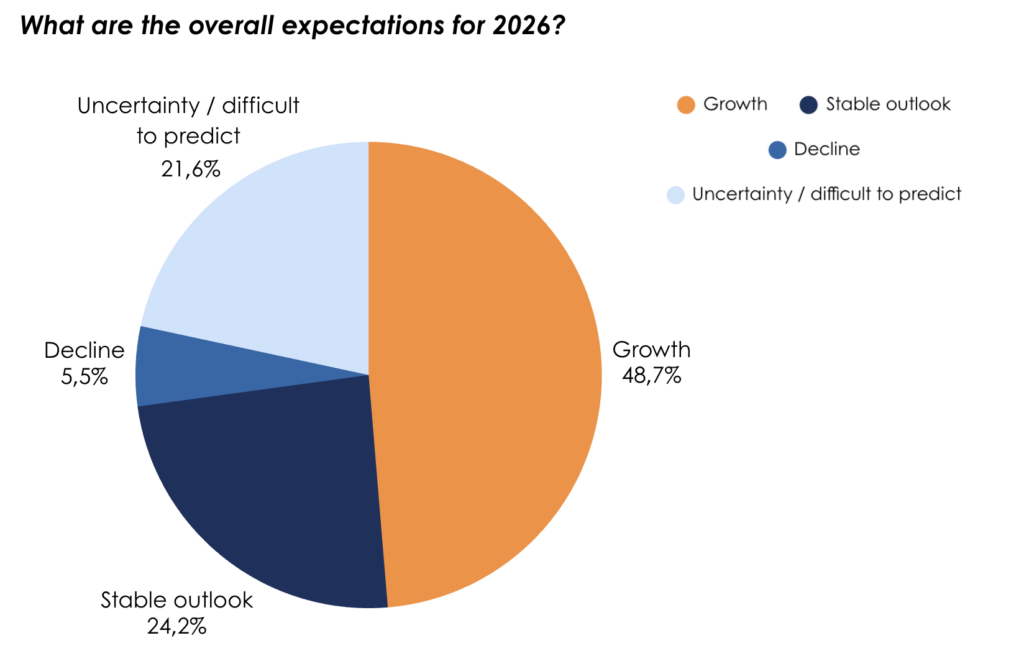
54.6% of small and medium-sized enterprises expect to grow in 2026 — a figure that comfortably exceeds the 46.2% recorded among large companies. This is not a marginal difference. It reflects a deeper structural reality: in an environment defined by speed of adaptation, agility is a competitive advantage. SMEs, with leaner decision-making structures and a higher tolerance for market pivoting, appear to be navigating geopolitical fragmentation more effectively than their larger counterparts.
Large corporations, for their part, are channeling their optimism elsewhere. More than 70% of large companies see artificial intelligence and digitalization as a key business opportunity — compared to just 53% among SMEs. The picture that emerges is of two different strategies responding to the same disruption: SMEs expanding outward, large companies optimizing inward.
AI and Digitalization: The Great Dividing Line
Across all company sizes, regions, and sectors, one theme dominates the opportunity landscape: artificial intelligence and digitalization.
Nearly 60% of companies identified AI and digital transformation as their top business opportunity — ahead of access to new markets (48%) and product or service innovation. This is not a passing trend. It reflects a structural shift in how international businesses are building competitive advantage: through productivity gains, faster decision-making, and the development of new revenue streams enabled by technology.
At the same time, AI is not without anxiety. 19.2% of respondents flagged it as a potential threat — ranking just below regulatory concerns (34%) and international instability (52%). The message is clear: companies that fail to integrate AI risk being left behind, but those that do so without a clear strategy face regulatory and operational exposure of their own.
For SMEs, this creates both an opportunity and an obligation. The barriers to AI adoption are lower than ever. The cost of inaction is rising faster than most companies realize.

Strategic Priorities: How Companies Are Responding
The study also offers a detailed picture of the strategic priorities guiding international expansion decisions in 2026.
Among SMEs, international market diversification is the leading strategy at 38% — a logical response to a world where no single market can be considered stable. For large companies, the priority shifts to cost optimization at 37%, reflecting the pressure to maintain margins in a high-tariff, high-energy-cost environment.
Both strategies point to the same underlying reality: the era of frictionless globalization is over. Companies are no longer expanding because it is easy. They are expanding — or consolidating — because they have developed a clearer-eyed view of where value lies and how to protect it.
Regional diversification is particularly evident in the supply chain data. The study documents a clear migration away from single-country dependency models. The China+N framework — expanding manufacturing and sourcing relationships across multiple countries rather than concentrating exposure in one backup market — is becoming standard practice for internationally active firms.
What This Means for Internationally Active Companies
The Gedeth Research Center’s 2026 study arrives at a moment of strategic reckoning for businesses with international ambitions. The environment is harder. The rules are changing faster. And the companies that are thriving are those that have built resilience into the architecture of their operations — not as a contingency plan, but as a core capability.
Several practical conclusions stand out for companies planning their next international move:
Diversification is no longer optional. Whether in supply chains, markets, or revenue sources, concentration carries risk that the post-conflict environment makes visible and immediate.
Size is not a proxy for resilience. The study’s finding that SMEs outpace large corporations in growth optimism should prompt a rethink of how agility is built and measured inside organizations of all sizes.
AI adoption is a strategic imperative. The 60% of companies that see AI as their primary opportunity are not chasing a trend. They are investing in the operational foundation of the next decade of international competition.
Geopolitics requires active management. The data shows that companies caught off-guard by the Iran conflict were disproportionately affected. Those who had already built geopolitical scenario planning into their strategy adapted faster and retained more of their original growth outlook.

Download the Full Report
The complete findings of «Resilience in a Fragmented World: How Companies Are Adapting to the New Geopolitics of Trade» are available to download at no cost. The report includes detailed breakdowns by region, company size, sector, and business function, as well as strategic recommendations developed by the Gedeth Research Center team.
If you would like to discuss how these findings apply to your company’s international expansion strategy, our team of specialists is available to help you design a roadmap built for the realities of 2026 and beyond.