

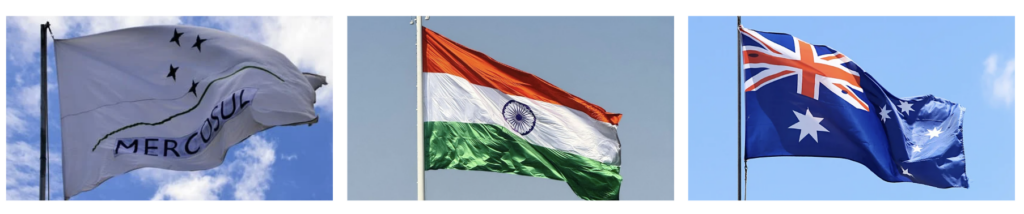
In the space of barely ten weeks at the start of 2026, the European Union concluded free trade agreements with three of the world’s most strategically important markets: Mercosur in January, India in late January, and Australia in March. Three deals. Three continents. A combined population of nearly three billion people. This is not a coincidence. It is a strategy, and understanding it matters for any company thinking seriously about where global trade is heading.
The Context: Why Now
The backdrop to this dealmaking sprint is not hard to read. The return of aggressive tariff politics in the United States, the fragmentation of global supply chains accelerated by the pandemic, and the growing pressure to reduce European dependence on China for critical materials have all pushed Brussels to act with unusual urgency. The EU needed to diversify. It needed reliable partners for raw materials, growing consumer markets for its exports, and political allies willing to operate within a rules-based trade framework. The trilogy delivers on all three fronts simultaneously.
European Commission President von der Leyen captured the moment when she described the India agreement — the largest trade deal either party has ever signed — as the «mother of all deals.» Creating a free trade zone of two billion people representing roughly a quarter of global GDP, that description is hard to dispute. But the ambition behind it extends well beyond any single agreement.
The Three Pillars
Mercosur — signed January 17, 2026 after more than 25 years of negotiation — creates one of the largest free trade areas in the world, covering 700 million consumers across 31 countries. For European companies, it eliminates tariffs that previously reached 35% on vehicles and 14% on pharmaceuticals exported to Argentina, Brazil, Paraguay, and Uruguay. In return, it opens the European market to South American agricultural products and, crucially, secures EU access to the region’s extraordinary raw material wealth: nickel, copper, aluminium, lithium. The agreement provisionally entered into force on May 1, 2026, though a legal review requested by the European Parliament could complicate full ratification.
India — concluded January 27, 2026 — removes or reduces tariffs on 96.6% of EU exports to a market of 1.4 billion people growing at over 6% annually. The gains are concrete: tariffs on machinery drop from up to 44%, on chemicals from 22%, on pharmaceuticals from 11%. Wine tariffs fall from 150% to between 20-30%. For European exporters in automotive, industrial equipment, and agri-food, India has historically been one of the most tariff-protected large markets in the world. That changes now. The Bundesbank estimates the long-term economic potential of this agreement as significantly greater than the immediate figures suggest, precisely because India is still early in its consumption growth curve.
Australia — concluded March 24, 2026 — eliminates more than 99% of Australian tariffs on European products, with projected annual savings exceeding €1 billion. EU exports to Australia — already worth €89 billion in goods and services annually, supporting 460,000 European jobs — are expected to grow by 33% over the next decade. Beyond the trade numbers, the agreement includes a Security and Defence Partnership, reflecting Australia’s role not just as a commercial partner but as a strategic ally in the Indo-Pacific. For European companies in machinery, vehicles, chemicals, agri-food, and critical minerals, it opens one of the world’s highest-income markets on genuinely preferential terms.
What the Three Deals Have in Common
Each of these agreements addresses a different dimension of Europe’s strategic exposure. Mercosur secures supply chain resilience and access to the raw materials the energy transition requires. India unlocks the largest emerging consumer market that has been systematically closed to European goods. Australia provides a stable, high-income, rule-of-law anchor in the Asia-Pacific alongside access to the world’s most important critical minerals portfolio.
Together they represent a deliberate effort to reduce Europe’s dependence on any single supplier, any single market, and any single political relationship. The Bundesbank put it plainly in its February analysis: the agreements send an important political signal that multilateral cooperation and trade liberalisation remain possible in an era of unilateral, interest-driven policies and protectionist tendencies.
There are risks. The Mercosur deal faces a potential two-year delay if the European Court of Justice is asked to rule on its compatibility with EU law. The India deal, for all its ambition, leaves sensitive agricultural sectors protected on both sides. And implementation of any of these agreements depends on political continuity in multiple capitals. Trade agreements signed are not the same as trade agreements functioning.
What It Means in Practice
For companies — whether European exporters, global investors, or businesses in the markets concerned — the trilogy creates a window of opportunity that did not exist twelve months ago. Markets that were expensive to enter are becoming cheaper. Supply chains that were fragile are gaining alternatives. Commercial relationships that took years to build can now be backed by a preferential legal framework.
The companies that map their product lines against the tariff schedules now, identify the right local partners in each market, and begin building relationships ahead of full implementation will arrive with structural advantages that latecomers will not easily close.
At Gedeth Network, we operate across all three of these geographies, Latin America, India, and Australia, with offices in Buenos Aires, Sydney, and Singapore, and partner networks covering the full extent of each market. If your company is evaluating what the EU’s trade trilogy means for your specific sector or expansion strategy, we would be glad to discuss it. Write to us at contacto@gedeth.com or visit ww.gedeth.com.