
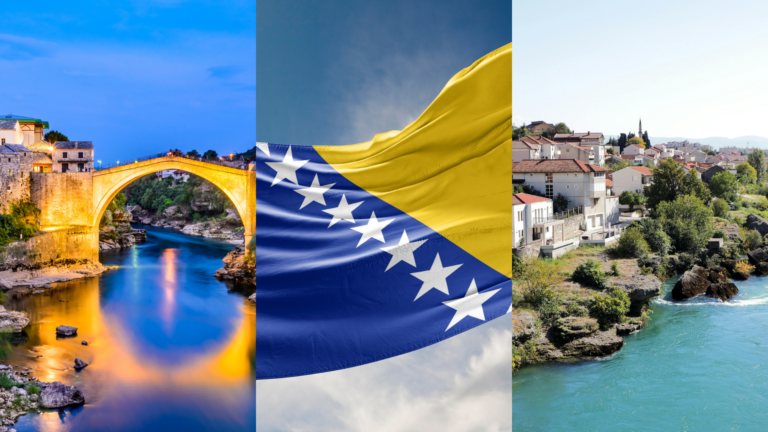
The Bosnia & Herzegovina economy 2026 is not the story most investors are telling themselves. EU candidate status granted in 2022, accession negotiations opened in 2024, a €6 billion EU Growth Plan already flowing, and an industrial base that has been quietly supplying European automotive chains for decades — none of this is generating the attention it deserves.
That asymmetry is the point. The companies that positioned themselves early in previous EU candidate economies captured the best entry conditions before competition arrived and valuations adjusted. Bosnia & Herzegovina is at that exact stage in 2026 — early enough that the opportunity is still underpriced, late enough that the direction of travel is no longer speculative. The question is not whether the country is moving toward Europe. It is whether your company moves before or after everyone else notices.


Bosnia & Herzegovina Economy 2026: Economic Outlook
The Bosnia & Herzegovina economy 2026 is growing at 2.2% according to the International Monetary Fund, with the IMF’s own Article IV staff assessment expressing optimism toward 3.6% average growth in 2026–2027 if structural reforms continue on track. The economy expanded by 3.0% in 2025, driven primarily by household consumption, construction activity linked to EU-funded infrastructure, and resilient exports. The convertible mark (BAM) remains pegged to the euro at a fixed rate — a deliberate and long-standing monetary arrangement that eliminates currency risk for eurozone-based investors and importers.
The EU accession process is the single most important structural force shaping the country’s trajectory. Bosnia & Herzegovina received EU candidate status in December 2022 and the European Council formally decided to open accession negotiations in March 2024. The EU is already the country’s largest trade partner, largest investor, and largest provider of financial assistance. A €6 billion Reform and Growth Facility for the Western Balkans is now operational, with funds conditional on reform delivery. In January 2026, the European Commission announced a €171 million support package specifically for BiH covering infrastructure, SME development, and public-private partnership capacity.
The domestic complexity is real and should be understood rather than avoided. Bosnia & Herzegovina operates as one country with two entities — the Federation of Bosnia and Herzegovina (FBiH) and Republika Srpska (RS) — plus the self-governing Brčko District. A company setting up in Sarajevo navigates Federation-level and cantonal regulations; one operating in Banja Luka works within the Republika Srpska framework. This layered structure adds friction to market entry, but it is navigable with experienced local counsel — and it is precisely the kind of complexity that deters less committed entrants, keeping the competitive field thinner than the opportunity warrants.
“Directors underscored the importance of maintaining political stability, avoiding policy slippages, and leveraging the EU accession process to accelerate reforms. Accelerating structural reforms and advancing EU accession would support income convergence.”
— IMF Article IV Consultation · Bosnia and Herzegovina · September 2025
Sectors with the Greatest Growth Potential

EV Supply Chain

Green Transition

Construction

Agrifood
Automotive Components and EV Supply Chain
Bosnia & Herzegovina’s most developed export sector is also its most time-sensitive opportunity. The motor vehicle parts and accessories manufacturing industry reached a market size of €336.4 million in 2026, growing at 5.1% annually. BiH companies produce seats, exhaust systems, cables, electrical components, and chassis parts for European OEMs — with over 80% of production exported, primarily to Germany, Austria, Croatia, the Netherlands, and Slovenia. The critical dynamic in 2026 is the EV transition pressure: 59% of BiH automotive companies currently operate below average technological competence, and only 13% are above average. That gap — between where the supply chain is and where European OEMs need it to be — is a direct entry point for companies offering EV component technology, process automation, and quality certification support.
Renewable Energy and the Green Transition
BiH is richly endowed with renewable energy potential — significant hydropower capacity already in operation, strong solar irradiation across Herzegovina, and wind resources in elevated terrain. The EU accession process requires alignment with the European Green Deal, which is accelerating the phaseout of coal and creating a structured mandate for renewables investment. The Western Balkans Investment Framework (WBIF) is channelling EU pre-accession funds specifically into clean energy infrastructure, and the €6 billion Growth Plan identifies the green transition as one of its two core pillars alongside digitalisation. For international companies in solar EPC, wind development, energy storage, and grid modernisation, BiH offers a combination of natural resource endowment, EU regulatory alignment pressure, and WBIF co-financing that reduces commercial risk significantly.
Infrastructure and Construction
BiH has one of the lowest road densities in Europe and a rail network that requires substantial modernisation to meet EU connectivity standards. This is not a liability — it is a decade-long procurement pipeline. The EU has already funded 98 km of motorways and the pipeline of transport, digital, water, and energy infrastructure projects backed by IPA III funding and the WBIF is substantial and growing. The January 2026 €171 million EU support package specifically included infrastructure contributions for BiH. For engineering firms, construction companies, project finance specialists, and infrastructure technology providers, the combination of EU-guaranteed demand and a relatively uncontested competitive landscape makes this one of the clearest B2B entry vectors in the Western Balkans.
Tourism and Agrifood
Sarajevo, Mostar, Trebinje, and the Neretva River valley offer cultural and natural attractions that are genuinely world-class and largely undiscovered by mass tourism. Visitor numbers have grown consistently since 2022, and the country’s position within a broader Western Balkans tourism corridor is strengthening. The agrifood sector benefits from clean land, traditional food culture, and growing EU market access as accession alignment removes non-tariff barriers. For companies in hospitality technology, sustainable tourism infrastructure, food processing, and organic certification, BiH offers early-mover positioning in a market where the infrastructure gap between current state and EU-standard operation defines the commercial opportunity.
Trends Redefining the Bosnia & Herzegovina Economy 2026
The forces reshaping the Bosnia & Herzegovina economy 2026 are not cyclical. They are structural, externally anchored, and moving on a timeline set by the EU accession process rather than by domestic political sentiment. That external anchor is what distinguishes this moment from earlier periods of reform optimism in the country.
The EU Accession Effect: Reform With External Accountability
The most important development in BiH’s economic trajectory is the activation of the EU Growth Plan’s conditionality mechanism. At the EU–Western Balkans Tivat Summit in June 2026, EU Enlargement Commissioner Marta Kos warned that over €700 million in EU funds is at risk across the region if reforms are not completed by the December 2026 deadline for BiH specifically. That pressure is real and producing measurable output: a Reform Agenda submitted by the BiH authorities in September 2025 and now under European Commission assessment. For international companies, EU conditionality is the most reliable indicator that reform momentum will be maintained regardless of domestic political dynamics.
The Currency Board Advantage
Bosnia & Herzegovina’s convertible mark has been pegged to the euro at a fixed rate since 1998 through a currency board arrangement. This means there is no exchange rate risk for eurozone investors, no monetary policy discretion that could introduce FX volatility, and a structural commitment to macroeconomic stability that has held through multiple global crises. For companies evaluating Central and Eastern European markets and weighing currency exposure, BiH’s effectively euroised environment is an underappreciated differentiator.
The Diaspora as a Commercial Bridge
Over 1.3 million BiH nationals live across the EU — primarily in Germany, Austria, Switzerland, and Sweden. Remittances represent a significant share of GDP and sustain domestic consumption beyond what the formal economy alone would support. More strategically for international companies, the diaspora community represents an established commercial and cultural bridge between BiH and Western European markets. Diaspora-owned businesses in Germany and Austria are active investors in BiH, and their networks provide introduction pathways, local knowledge, and partnership structures that reduce the time and cost of market entry for foreign companies.
Opportunities for International Companies
The geographic logic of entry maps cleanly onto BiH’s economic structure. Sarajevo is the commercial, financial, and diplomatic hub — the right base for professional services, regional headquarters, and companies whose primary interface is with central government institutions. Mostar and the Herzegovina region offer access to the automotive and agrifood clusters and proximity to the Croatian border and Adriatic logistics corridor. Banja Luka, as the administrative centre of Republika Srpska, is the entry point for companies operating within the RS regulatory framework — relevant for energy, manufacturing, and logistics investments in the northern and western parts of the country.
Entry mechanisms are more straightforward than the country’s reputation suggests. The standard vehicle is a d.o.o. (društvo s ograničenom odgovornošću), BiH’s equivalent of a private limited company, facilitated by the Foreign Investment Promotion Agency (FIPA). Investment incentives include a flat corporate income tax rate of 10% — one of the lowest in Europe — VAT refund procedures, and customs duty exemptions on equipment imports for qualifying investments. EU pre-accession alignment is progressively harmonising the regulatory environment with EU standards, reducing the long-term compliance risk for companies that build to European specifications from the outset.
Barriers to consider: The two-entity structure means that a national operating licence in one entity does not automatically extend to the other — companies with operations in both FBiH and RS must navigate parallel regulatory frameworks, which requires experienced local legal counsel from day one. Corruption perceptions remain elevated and due diligence on local partners and public procurement processes is non-negotiable. Judicial enforcement of contracts, while improving, can be slow by EU standards. Infrastructure gaps — particularly in logistics and digital connectivity outside major urban centres — affect operational timelines. None of these barriers are prohibitive for a company that enters with a clear structure, a vetted local partner, and a medium-term horizon.
Bosnia & Herzegovina Economy 2026: Macroeconomic Outlook for Investors
The Central Bank of Bosnia and Herzegovina (CBBH) operates a currency board — meaning it cannot conduct conventional monetary policy, set interest rates, or print money. The BAM is fully backed by euro reserves at a fixed parity. This arrangement, in place since 1998, has provided remarkable macroeconomic stability. Inflation, which peaked above 7% in 2022–2023, has eased to approximately 4.5% and is forecast to continue declining toward the 2–3% range by 2027 as energy price pressures subside and EU alignment disciplines domestic pricing.
The fiscal outlook is manageable. The IMF projects a return to primary budget surplus in 2027, supported by highway-related revenues and a stable VAT regime. Public debt is moderate by regional standards. For investors, the combination of a de facto euro environment, a 10% flat corporate tax, EU pre-accession fund co-financing availability, and a reform trajectory externally monitored by the European Commission represents a risk-adjusted profile that is materially more attractive than the country’s headline complexity suggests. The IMF baseline scenario of 3.6% average growth in 2026–2027 — if reforms stay on track — would place BiH among the faster-growing economies in the broader European neighbourhood.
Conclusions
The Bosnia & Herzegovina economy 2026 rewards the investor who reads the structural signals rather than the surface complexity. EU candidate status, open accession negotiations, a €6 billion EU Growth Plan with operational conditionality, a fixed-parity currency eliminating FX risk, a 10% corporate tax rate, and an automotive supply chain actively seeking the technology partnerships it needs to survive the EV transition — these are not aspirational features. They are present realities, and they are not yet priced into the level of international commercial attention the country receives.
The strategic question is not whether Bosnia & Herzegovina is on a trajectory toward EU standards and deeper European integration. That direction is now externally anchored in a way that previous reform cycles were not. The question is whether your company’s sector, entry structure, and timeline align with the specific moment the country is in right now — early enough in the accession cycle that first-mover advantages are real, late enough that the institutional and legal infrastructure for foreign investment is functional and improving. That window does not stay open indefinitely.
Thinking about entering the Bosnia & Herzegovina market?
Gedeth Network helps international companies analyse, plan and execute their expansion into Bosnia & Herzegovina — from market entry strategy to local partner identification and commercial launch.
Talk to our team