
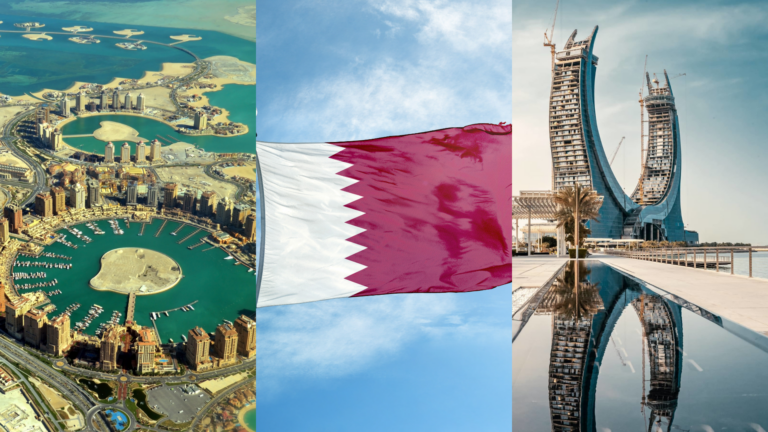
The Qatar economy 2026 spent $220 billion preparing for 2022. Most of the global conversation ended when the tournament did. The article picks up where everyone stopped paying attention — because what Qatar built for a football tournament is now a platform for a decade of B2B opportunity, and the companies arriving now are not competing with a crowd.
The World Cup didn’t just deliver stadiums. It delivered a metro system, the largest deepwater port in the Middle East, a fully wired smart city in Lusail designed for 200,000 residents, a hospitality infrastructure upgraded from adequate to world-class, and a government procurement machine that is still running at full speed. GDP is projected to grow at 5.2% in 2026 and accelerate to 7.9% in 2027 as the North Field East LNG expansion comes online. The non-oil economy now represents over 65% of total GDP. The question for international companies is not whether Qatar is open. It is whether they are positioned to compete for what is being built on top of the infrastructure that is already there.


Qatar Economy 2026: GDP Growth and Economic Outlook
The Qatar economy 2026 is in a specific phase of its development cycle that does not happen often: an economy with extraordinary financial resources, a clear strategic roadmap, and an infrastructure base that is already built — now actively looking for the private sector expertise and technology to fill it. The International Monetary Fund projects real GDP growth at 5.2% for 2026, more than doubling the 2.4% rate of 2025, driven by the ramp-up of the North Field East LNG expansion and continued non-hydrocarbon sector growth. The Ministry of Finance’s own projections point to 7.9% growth in 2027 — the highest projected growth rate in the GCC for that year.
The non-hydrocarbon economy is the structural story. Non-oil sectors now represent over 65% of Qatar’s total GDP and grew 3.7% in 2024, led by education (+14.4%), accommodation and food services (+8.7%), arts and entertainment (+7.5%), and transportation (+5.4%). Foreign direct investment grew 109.6% in 2024, reaching $2.7 billion across 241 projects — 74% of which were greenfield investments. Over 12,400 foreign companies registered in Qatar in a single year, a 600% increase from the year before. The Qatar Investment Authority (QIA) sovereign wealth fund, estimated at $510 billion, is actively deploying capital into domestic diversification sectors, creating a co-investment environment that is increasingly accessible to international companies with relevant expertise.
The fiscal position is exceptional. Qatar has run consecutive fiscal surpluses, with a current account balance projected at 10.2% of GDP in 2026. Gross public debt has fallen from 72.6% of GDP in 2020 to approximately 41% today. The government has zero personal income tax, a 10% flat corporate tax rate at the Qatar Financial Centre (QFC), and a national commitment to 100% foreign ownership across most sectors under the Foreign Investment Law (Law No. 1 of 2019). For international companies, this is not a frontier market requiring patience — it is a high-income, high-stability market with infrastructure already in place and the procurement pipeline already funded.
“Qatar’s digital investments across priority technologies are expected to soar to $5.7 billion by 2026, up from $1.65 billion in 2022. Qatar is home to the world’s first commercially available 5G network and is ranked first for internet adoption globally with nearly 100% penetration.”
— Invest Qatar & MCIT · Smarter Qatar Report · March 2026
Sectors with the Greatest Growth Potential

Digital Technology

MedTech

Fintech

Hospitality Tech
Smart City Technology and Digital Infrastructure
Lusail City — Qatar’s purpose-built smart city north of Doha — is designed to accommodate over 200,000 residents by 2030 and is still in active development across 19 districts. The city integrates city-wide Wi-Fi, a fibre optic backbone, IoT systems, autonomous transit, and AI-powered utilities into a single urban platform. The government’s TASMU Smart Qatar Programme has identified 15 priority technologies for national deployment — including AI, IoT, and cybersecurity — and is actively seeking private sector partners to deliver them into healthcare, transport, and logistics. Qatar’s cybersecurity spending alone reached $1.64 billion in 2024, the fastest-growing cybersecurity budget in the Middle East. For international technology companies, the combination of funded government procurement, 5G infrastructure already live nationwide, and a 100% foreign ownership pathway through the Qatar Free Zones Authority (QFZA) makes this the most immediately accessible sector in the country.
Healthcare and Medical Technology
Qatar’s public healthcare system, anchored by Hamad Medical Corporation and Sidra Medicine, is among the most advanced in the Gulf. But the private sector remains undersupplied. The specific gaps are well-defined: private specialist clinics, mental health services, digital health platforms, and medical technology are all areas where supply does not yet meet demand. The QFC licenses healthcare advisory and digital health firms without requiring a local partner, with setup typically completed in two to four weeks under English-style commercial law. The TASMU programme has healthcare as one of its five transformation pillars, creating a direct procurement pathway for digital health platforms, telemedicine infrastructure, clinical data management systems, and patient experience technology.
Financial Services and Fintech
The Qatar Financial Centre (QFC) is home to over 1,000 registered firms spanning banking, insurance, asset management, and fintech. It operates under English common law, offers a 10% corporate tax rate, allows 100% foreign ownership, and permits full profit repatriation — making it one of the most structured and investor-friendly financial services environments in the region. The Qatar FinTech Hub (QFTH) operates the country’s first specialised fintech incubator and accelerator, driving demand for payment solutions, digital lending platforms, Islamic fintech products, and blockchain-based financial services. Financial services are targeted to reach QAR 84 billion by 2030 under the Third National Development Strategy.
Tourism and Hospitality Technology
Qatar’s tourism sector exceeded its 4.79 million visitor target in 2024, reaching 5.08 million, and the official goal is 6 million annual visitors by 2030 — representing 12% of GDP from tourism alone. The World Cup created a world-class hospitality infrastructure: luxury hotels, a modernised Hamad International Airport, a fully operational metro, and an events calendar that now runs year-round. The post-tournament opportunity is in the technology and operational expertise needed to run it at the standard a high-income international visitor expects. Property management systems, revenue optimisation platforms, destination analytics, loyalty technology, and sustainable hospitality certification are all in active demand.
Trends Redefining the Qatar Economy 2026
Three forces are running simultaneously in 2026 that make this a specific moment rather than a general one. Each creates demand that the domestic market cannot fully supply alone, and each is backed by government funding at a scale that removes the usual commercial uncertainty from early-stage market entry.
The North Field Dividend: LNG Revenue Funding Diversification
The North Field East project — the largest LNG expansion in history — will increase Qatar’s production capacity from 77 million tonnes per annum to 142 million by 2030, with the first phase online in 2026. The additional government revenue is being channelled directly into the diversification agenda: the non-oil project pipeline through 2030 exceeds $150 billion. For international companies, the North Field expansion is not a sector to enter directly. It is the fiscal engine that makes every other sector on this list commercially real.
Vision 2030 Is in Its Execution Phase
Qatar National Vision 2030 launched in 2008 and its Third National Development Strategy (NDS3), launched in January 2024, is now in full execution. NDS3 targets $100 billion in total foreign direct investment by 2030. In 2024, FDI grew 109.6% year-on-year, with the leading sectors being technology, professional services, fintech, and engineering. New laws in 2025 updating business regulations, a streamlined company formation process, and the expansion of 100% foreign ownership across most industries have reduced the structural friction that historically deterred international companies from entering the market.
Education City and the Knowledge Economy
Qatar’s Education City hosts branches of eight international universities including Georgetown, Northwestern, and Carnegie Mellon. The education market is projected to grow from $8.5 billion in 2025 to $13 billion by 2034. International school operators, EdTech companies, vocational training providers, and professional development firms all have a clear path into this market. The Qatar Foundation and Qatar Science and Technology Park (QSTP) provide incubation, funding, and research partnerships for technology firms entering the market.
Opportunities for International Companies
The geographic concentration of opportunity in the Qatar economy 2026 is unusual: almost everything relevant happens in Doha and its immediate expansion zones. West Bay is the financial and corporate district. Lusail is the smart city and technology hub. Msheireb Downtown Doha is the world’s first fully sustainable smart district. The Qatar Financial Centre, the Qatar Free Zones Authority, and the mainland Ministry of Commerce and Industry (MOCI) represent three distinct entry routes — the right choice determined by who your customers are: QFC for financial services, fintech, and professional services; QFZA free zones for logistics, manufacturing, and port-adjacent businesses; mainland MOCI registration for companies whose primary clients are government ministries.
Entry is operationally straightforward by Gulf standards. The QFC completes registration in two to four weeks under English-style commercial law with no minimum capital requirement for most business categories. Full profit repatriation is permitted. Corporate tax at the QFC is a flat 10% with no personal income tax. The Foreign Investment Law (Law No. 1 of 2019) allows 100% foreign ownership across most sectors — a meaningful shift from the historical position that deterred many companies from prioritising the market.
Barriers to consider: Qatar’s domestic market is small at approximately 3 million people — roughly 85% expatriates — creating a fluid workforce that affects long-term talent retention planning. Qatarisation policies affect hiring structures and must be built into operational planning from the outset. Government procurement cycles, while funded, can be slow and relationship-dependent. The Strait of Hormuz disruptions of early 2026 were a reminder that Qatar’s stability, while genuine, is not immune to regional dynamics. Companies entering for the long term should factor this into their risk framework without letting it dominate the commercial case.
Qatar Economy 2026: Macroeconomic Outlook for Investors
The Qatar Central Bank (QCB) manages monetary policy within a fixed exchange rate framework — the Qatari riyal has been pegged to the US dollar at 3.64 QAR/USD since 1980, eliminating currency risk for dollar-denominated businesses. Inflation is projected at 2.6% in 2026, low by regional standards. The current account balance is projected at 10.2% of GDP in 2026, one of the highest ratios in the world. Fitch Ratings maintained Qatar’s AA− sovereign credit rating in 2026, citing the gas production expansion, the QIA’s $510 billion buffer, and continued fiscal prudence.
For international companies, the macroeconomic case is simple: Qatar is one of the wealthiest countries per capita in the world, with a fixed exchange rate, no personal income tax, a 10% corporate rate at the QFC, and a government actively spending to build a post-hydrocarbon economy. The Qatar economy 2026 is not a market where you wait for conditions to improve. The conditions are already there. The question is whether your company arrives before the next wave of competition does.
Conclusions
The Qatar economy 2026 rewards the company that reads the infrastructure map rather than the population count. At 3 million people, Qatar is not a mass market. It is a high-income procurement market with $510 billion in sovereign wealth, a $150 billion non-oil project pipeline through 2030, GDP growing at 5.2% in 2026 and accelerating to 7.9% in 2027, and a government that has built the physical platform and is now actively buying the technology, expertise, and services to operate it at the standard its Vision 2030 ambitions require.
The strategic question for companies evaluating the Qatar economy 2026 is not whether the purchasing power is real — it is. It is whether your offering maps onto one of the sectors where the government is spending right now: smart city technology, healthcare, financial services, hospitality, education, or logistics. If it does, the entry infrastructure — QFC, QFZA, 100% foreign ownership, English-law contracts — is already in place. The platform was built for the World Cup. The decade of returns is only just beginning.
Thinking about entering the Qatari market?
Gedeth Network helps international companies analyse, plan and execute their expansion into Qatar — from market entry strategy to local partner identification and QFC registration.
Talk to our team