
The Haiti economy 2026 is one of the most difficult assessments any international business analyst must write honestly. The GDP contracted for a seventh consecutive year in 2025. Inflation is running at 28.3%. Violence has displaced 1.4 million people. The IMF projects GDP at -1.7% for 2026. Any article that presents Haiti as a conventional market entry destination without acknowledging this reality fails the reader before it begins.
This article does not do that. What it does instead is make the case that a specific, narrow, and carefully structured set of international engagements in Haiti are both commercially viable and genuinely consequential — and that the companies and organisations best positioned to pursue them are those that understand the difference between conventional market entry and reconstruction investment. Haiti has a garment sector generating 90% of its exports with duty-free US access that expires at the end of 2026. It has remittances representing over 20% of GDP, the largest single source of foreign exchange. It has a World Bank strategic partnership committing $320 million in grant financing through 2029. And it has natural resources, agricultural potential, and a young population of 12.7 million that, under stable conditions, represent the raw material of a very different economic story. The Haiti economy 2026 is not an opportunity to ignore. It is an opportunity to read correctly.


Haiti Economy 2026: Economic Outlook
The Haiti economy 2026 requires a different analytical framework than any other country in this series. The standard market entry metrics — GDP growth, FDI inflows, ease of doing business — do not capture what is actually happening in Haiti, nor do they point toward where the real commercial and impact opportunities lie. The World Bank’s assessment is direct: the economy contracted for a seventh consecutive year in 2025, real GDP fell 2.7%, all economic sectors declined, and inflation averaged 28.3%. The share of Haitians living on less than $3.00 per day (2021 PPP) is estimated at 49% in 2025, up from 42.2% in 2021. Forced displacement doubled from approximately 700,000 in September 2024 to 1.4 million by March 2026.
The International Monetary Fund projects GDP growth at -1.7% for 2026. Modest positive growth is possible in the second half of 2026, subject to gradual security improvements supported by the Multinational Security Support (MSS) Mission — now operating as the Gang Suppression Force (GSF) — and the planned completion of elections by late 2026. The outlook remains fragile. The expiration of preferential trade access for the garment sector at end-2026 under the HOPE/HELP Act creates a structural economic risk that is real and time-sensitive. Remittance flows — which represent over 20% of GDP and are the single most important source of income for millions of Haitian households — are under uncertainty from evolving regional migration policies that affect the Haitian diaspora in the United States.
Against this backdrop, the World Bank Group’s Board of Directors endorsed in March 2025 a new Country Partnership Framework for Haiti for the 2025–2029 period, committing approximately $320 million in grant financing. The strategy focuses on three priorities: laying a foundation for economic and social recovery, mitigating risks of further deterioration of human capital and physical infrastructure, and building resilience among the most vulnerable. The IFC supports the private sector through advisory services, and MIGA provides financial guarantees for qualifying private investment. For international companies and organisations with the risk tolerance and long-term horizon required, this multilateral backing defines the institutional framework within which private engagement is possible.
“In March 2025, the World Bank Group’s Board of Directors endorsed a new strategic partnership for Haiti for the 2025–2029 period. The new plan focuses on laying a foundation for economic and social recovery, and will make approximately $320 million in grant financing available with the aim of building resilience among Haiti’s most vulnerable.”
— World Bank · Haiti Country Overview · 2026
Sectors Where Engagement Is Viable in 2026

Textile Manufacturing

Food Security

Reconstruction

Remittance Services
Garment and Textile Manufacturing
The garment sector is Haiti’s most developed industrial activity, accounting for approximately 90% of total exports and employing tens of thousands of workers in the industrial parks around Port-au-Prince, particularly the SONAPI industrial zone and the Caracol Industrial Park in the north. Haiti’s garment exports benefit from duty-free, quota-free access to the United States market under the HOPE (Haitian Hemispheric Opportunity through Partnership Encouragement) and HELP Acts — a trade preference framework that has been renewed multiple times since 2006 and is currently set to expire at end-2026. The renewal or extension of HOPE/HELP is the single most important trade policy decision affecting Haiti’s near-term economic outlook. For international garment companies evaluating nearshore production for the US market, Haiti’s combination of duty-free access, proximity to Miami (approximately 2.5 hours by air), competitive labour costs, and an established industrial park infrastructure represents a genuine commercial case — but one that is contingent on the security environment and the trade preference renewal being resolved.
Agriculture and Food Security
Approximately two-fifths of Haiti’s population depends on agriculture, primarily small-scale subsistence farming concentrated in rural areas that remain less affected by the urban gang violence centred on Port-au-Prince. Haiti has fertile land, adequate rainfall in many regions, and a tradition of production in mangoes, coffee, cocoa, vetiver (the world’s leading supplier of vetiver essential oil), and fresh produce. The food security crisis — with an estimated 5.4 million Haitians unable to find enough to eat daily — is driven primarily by supply chain disruption, displacement, and market access breakdown rather than solely by natural conditions. For companies and NGOs in agricultural supply chains, food processing, logistics, and climate-resilient farming technology, the combination of immediate humanitarian need and long-term agricultural potential creates a specific engagement context. The World Bank’s $320 million framework specifically identifies human capital and food security as priority investment areas.
Infrastructure and Reconstruction
Haiti’s infrastructure deficit is both a humanitarian challenge and a long-term commercial opportunity. Roads, energy, water, housing, and digital connectivity are all severely underdeveloped relative to the country’s needs. The World Bank Road Maintenance Plan represents one of the active public investment pipelines, and international construction and engineering companies operating within multilateral-funded project frameworks have a structured pathway to engagement that does not require direct exposure to the security environment in the same way that private commercial ventures do. For companies experienced in post-conflict or fragile-state reconstruction — particularly those with IFC, USAID, or World Bank project experience — Haiti’s reconstruction pipeline, while dependent on security improvements, represents a decade-long programme of work. The Caracol Industrial Park in the north of the country, funded by the Inter-American Development Bank and USAID, demonstrates that internationally backed industrial infrastructure can be built and operated at scale in Haiti under the right conditions.
Diaspora and Remittance Financial Services
Remittances to Haiti are the country’s largest source of foreign exchange — representing over 20% of GDP and, in absolute terms, more than twice the value of all formal exports. The Haitian diaspora in the United States, Canada, France, and the Dominican Republic sends an estimated $4–5 billion annually to family members in Haiti. This flow is the primary economic lifeline for millions of households and the most stable financial channel in an otherwise disrupted economy. For financial services companies, fintech operators, and mobile money providers, the remittance corridor to Haiti is a large, active, and underserved market. Transaction costs remain elevated compared with global best practice, creating a direct commercial opportunity for companies that can reduce friction and cost in the transfer process. The World Bank’s financial sector advisory work specifically identifies financial inclusion and remittance infrastructure improvement as priority areas.
Structural Assets That Define Haiti’s Long-Term Potential
A complete picture of the Haiti economy 2026 requires acknowledging the structural assets that make the long-term case, even when the near-term outlook is severely constrained. These are not reasons to minimise the current crisis — they are reasons why Haiti’s reconstruction, when it comes, will matter commercially as well as humanistically.
Geographic Position and US Market Access
Haiti occupies the western third of the island of Hispaniola, approximately 1,100 kilometres from Miami and 2.5 flying hours from the US eastern seaboard. This proximity — comparable to Dominican Republic, which has successfully built a major export manufacturing economy — gives Haiti structural nearshoring potential for the US market that is independent of the HOPE/HELP Act, though the Act makes it commercially immediate. Haiti is also 160 kilometres from Cuba and within the broader Caribbean Basin Initiative trade framework. For companies thinking about where Caribbean manufacturing capacity will be built over the next decade, Haiti’s geography is an asset that does not change regardless of the current political situation.
Young Population and Labour Force Potential
Haiti has a population of approximately 12.7 million with a young median age. Under stable conditions, this demographic profile represents a labour force with significant growth potential for labour-intensive manufacturing and services. The Dominican Republic — which shares the island of Hispaniola and has a comparable geographic position — has built a $10 billion+ export manufacturing sector employing hundreds of thousands of workers. Haiti’s labour force, currently underemployed and trapped in an informal economy, represents the human capital foundation for a similar trajectory if security and governance conditions improve.
Natural Resources and Tourism Potential
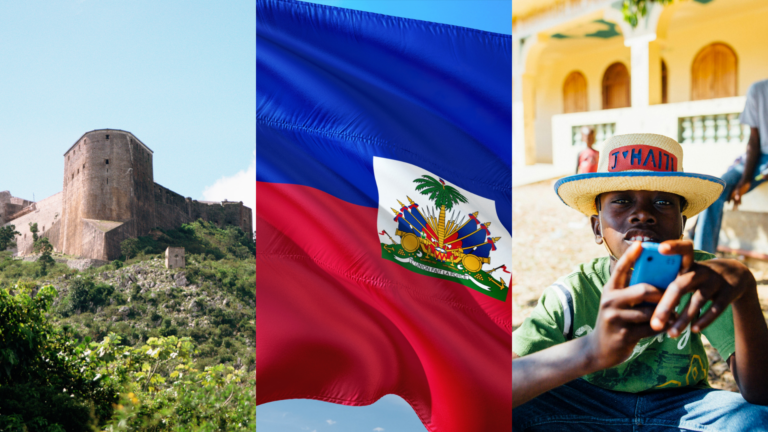
Haiti possesses significant natural resources including gold, copper, and bauxite deposits that have attracted exploration interest but remain underdeveloped due to governance and security challenges. The country’s northern coast, including Labadee — a private resort area leased to Royal Caribbean cruise line — and the historic Citadelle Laferrière and Sans-Souci Palace (both UNESCO World Heritage Sites) demonstrate that world-class tourism assets exist. Haiti was once described as the “Pearl of the Antilles” and its natural and cultural heritage, while severely underexploited, represents a long-term tourism development potential that no crisis permanently extinguishes.
Risk Framework for Companies Considering Engagement
Any company or organisation considering engagement with the Haiti economy 2026 must operate within a clear-eyed risk framework. The security environment in Port-au-Prince and surrounding areas remains severe, with gang control of large portions of the capital and major road corridors. The IMF’s baseline scenario for modest positive growth in 2026 is explicitly conditional on security improvements and electoral progress — neither of which is guaranteed. The Haitian gourde (HTG) has been depreciating against the US dollar, creating significant FX risk for businesses with USD cost structures and HTG revenue streams. Governance and anti-corruption frameworks, while a stated priority of the current authorities and their multilateral partners, remain weak by any objective measure.
The companies and organisations best positioned for Haiti engagement in 2026 share three characteristics. First, they operate within or alongside a multilateral framework — World Bank, IFC, USAID, IDB — that provides political risk mitigation, project financing, and institutional legitimacy. Second, they have experience in fragile or post-conflict environments and have built operational models that do not depend on conditions that Haiti cannot currently provide. Third, they have a genuine long-term horizon — five to ten years minimum — and understand that the commercial return on early positioning in a country undergoing genuine reconstruction can be substantial, but that it is measured in years, not quarters.
Engagement considerations: Companies entering Haiti should work through established industrial parks (SONAPI, Caracol) rather than greenfield locations; structure contracts in USD rather than HTG; engage local security assessment and crisis management professionals from day one; prioritise the northern and southern regions over Port-au-Prince for operational facilities where possible; ensure adequate political risk insurance through MIGA or comparable providers; and build relationships with the Haitian diaspora community as a source of business intelligence, partnership, and talent with both Haitian and international market experience.
Haiti Economy 2026: Macroeconomic Context for Investors
The Haitian gourde (HTG) has been under persistent depreciation pressure, driven by fiscal deficits, inflation, and reduced foreign exchange inflows. Government revenue declined to 4.8% of GDP in 2025 — one of the lowest tax-to-GDP ratios in the world — reflecting both the collapse of economic activity and the breakdown of tax collection mechanisms in areas controlled by armed groups. The fiscal deficit is financed primarily by central bank financing, contributing to the inflation spiral. Inflation averaged 28.3% in 2025 and is projected at 23.5% for 2026 — elevated but potentially beginning a slow decline if security conditions improve.
International reserves at the Banque de la République d’Haïti (BRH) remain under pressure, and the country’s capacity to service external obligations depends heavily on continued multilateral support. Outstanding IMF loans total approximately SDR 161.75 million as of March 2026. The World Bank, IDB, and bilateral donors collectively provide the majority of Haiti’s annual budget from external sources. This dependency on international financing is both a vulnerability and, for companies operating within that framework, a form of institutional backstop — the multilateral community has too much invested in Haiti’s stability to allow a complete financial collapse without intervention.
Conclusions
The Haiti economy 2026 is not a conventional market. It is a reconstruction opportunity that requires a specific type of company, a specific type of patience, and a specific type of engagement model. The companies that should not be in Haiti right now are those looking for a straightforward export market, a stable operating environment, or a short-term return on investment. The companies that may find a genuine and consequential role are those in garment manufacturing seeking US-market duty-free access, fintech and financial services companies serving the remittance corridor, engineering and construction firms with fragile-state project experience, agricultural technology and food security specialists working within humanitarian frameworks, and impact investors with the risk appetite and time horizon to position before the reconstruction dividend materialises.
The structural case for Haiti over a five-to-ten year horizon is real: geographic proximity to the US, a young population, agricultural potential, tourism assets, and a multilateral community that has committed to its recovery. The question for the Haiti economy 2026 is not whether that long-term potential exists. It is whether your organisation has the capabilities, the risk framework, and the commitment to engage now, when the conditions are most challenging and the early-mover position is most valuable.
Considering engagement with Haiti?
Gedeth Network helps companies and organisations assess, structure, and execute their engagement strategies in complex and emerging markets — including Haiti’s garment sector, reconstruction pipeline, and remittance infrastructure.
Talk to our team