
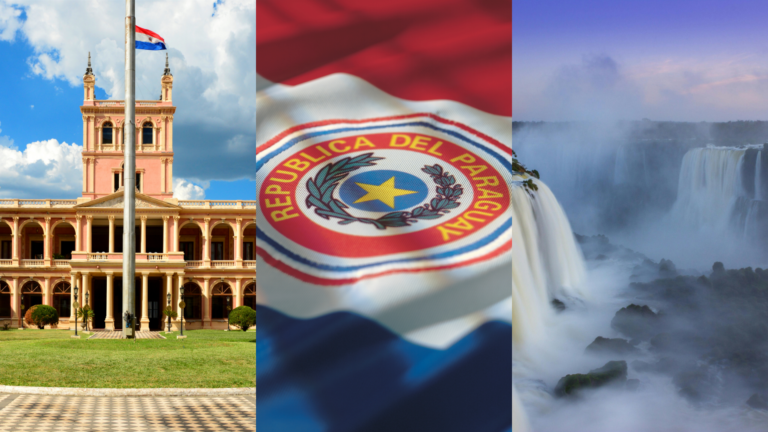
The Paraguay economy 2026 runs on the cheapest industrial electricity in Latin America — and almost no one in the international business community knows it. Itaipú, the second-largest hydroelectric dam in the world, sits on Paraguay’s border with Brazil and generates more power than the entire country can consume. The surplus is the commercial story: energy prices for industrial users that are a fraction of what companies pay in neighbouring markets, a structural cost advantage that is now drawing manufacturing, data centres, agribusiness processing, and green hydrogen projects to a country that Moody’s upgraded to investment grade just two years ago.
Paraguay grew 6.6% in 2025 — one of the highest rates in South America — with the Paraguay economy 2026 projected at 4.2% by the IMF and 4.3% average growth through 2028 by the World Bank. Inflation is 3.3%. Public debt is 41% of GDP, among the lowest in Latin America. The fiscal deficit is being reduced to 1.5% of GDP in 2026 under the Fiscal Responsibility Law. This is not a country at the beginning of a reform story. It is a country where the reform story is already in its execution phase — and the energy advantage is the reason the commercial opportunity is now.


Paraguay Economy 2026: GDP Growth and Economic Outlook
The Paraguay economy 2026 is one of the most consistently underreported growth stories in the Western Hemisphere. Real GDP growth reached 6.6% in 2025, exceeding all forecasts and positioning Paraguay as one of the most dynamic economies in Latin America. The International Monetary Fund projects 4.2% growth for 2026, with the World Bank projecting an average of 4.3% through 2028 — an upward revision reflecting stronger-than-expected domestic demand and sustained economic momentum. The IMF’s April 2026 Latin America outlook specifically highlighted Paraguay as “experiencing strong agricultural exports and a stable macro framework, making it one of the region’s fastest growing economies.”
The macroeconomic fundamentals are genuinely strong. Inflation is projected at 3.3% in 2026, within the Central Bank of Paraguay’s target range. Public debt stands at 41.3% of GDP — among the lowest ratios in Latin America and well below the regional average. The fiscal deficit is being reduced to 1.5% of GDP in 2026, the ceiling established by Paraguay’s Fiscal Responsibility Law, completing a three-year consolidation from 4.1% in 2023. Moody’s upgraded Paraguay to Baa3 (investment grade) in mid-2024, while S&P improved its outlook to positive in January 2025 and Fitch followed in October 2025. Sovereign spreads have declined to regional lows, reflecting this multi-agency confirmation of fiscal credibility.
The structural driver of this performance is straightforward: Paraguay operates Itaipú, which alone generates approximately 14% of all electricity consumed in Brazil, and the Yacyretá dam on the Argentine border. Paraguay uses roughly 20% of the power it generates — the rest is sold to Brazil and Argentina under long-term treaties. This arrangement gives Paraguay energy revenues that underpin fiscal stability and electricity prices for domestic industrial users that are, in structural terms, the cheapest on the continent. That price advantage is now the primary reason international companies in energy-intensive sectors are beginning to evaluate Paraguay as a serious manufacturing and nearshoring destination.
“Paraguay’s economy remains resilient despite global uncertainty. Real GDP growth is expected to stay robust in 2026 and thereafter, supported by macroeconomic stability and a wide range of reforms in train. Reflecting sound macroeconomic management and a strong record of institutional reforms, Moody’s upgraded Paraguay’s sovereign bonds to investment grade status in mid-2024.”
— IMF Country Report · Paraguay · January 2026
Sectors with the Greatest Growth Potential

Green Hydrogen

Nearshoring

Digital Infrastructure

Food Processing
Clean Energy and Green Hydrogen
Paraguay’s energy position is structurally unique. Itaipú — jointly operated with Brazil — and Yacyretá — jointly operated with Argentina — give Paraguay 100% renewable electricity generation from hydropower, at industrial tariffs that are a fraction of what competitors in Brazil, Argentina, or even Chile pay. The government is now actively leveraging this advantage to attract green hydrogen and green ammonia projects: Atome Energy, a UK-listed green fertiliser company, has signed agreements to develop one of South America’s first large-scale green hydrogen-to-ammonia plants in Paraguay, with construction targeted to begin once financing is finalised. For international companies in green energy, electrolysis equipment, industrial gas, and clean chemical production, Paraguay’s combination of certified renewable electricity at low cost, land availability, and Mercosur market access creates a competitive production platform that does not exist at the same cost anywhere else in the hemisphere.
Manufacturing and Energy-Intensive Nearshoring
The energy price advantage translates directly into operating cost advantages for any manufacturing process with significant electricity consumption — aluminium, steel, cement, chemicals, textiles, food processing, and electronics assembly. Paraguay operates four Special Economic Zones (the Maquila regime and specific SEZ frameworks) that offer exemptions from most domestic taxes, simplified customs procedures, and the ability to import inputs duty-free for re-export. The Maquila Law in particular has attracted assembly operations from Brazil, Argentina, and increasingly from Asian companies seeking a Mercosur production base. Paraguay’s labour costs remain competitive, the workforce is young (median age 26), and the country has Mercosur preferential access to a combined market of over 295 million people. For companies considering a South American manufacturing base, the energy cost arithmetic alone makes Paraguay worth a serious evaluation.
Data Centres and Digital Infrastructure
The same energy advantage that makes Paraguay attractive for industrial manufacturing makes it one of the most cost-competitive locations in Latin America for data centre operations. Electricity is the primary operating cost driver for data centres — cooling, servers, and power infrastructure — and Paraguay’s renewable, low-cost grid directly reduces that cost structure. The country has been attracting cryptocurrency mining operations for years, but the more durable opportunity is in hyperscale and co-location data centre infrastructure serving the Brazilian and Argentine digital economies from a lower-cost, politically stable jurisdiction. Paraguay has a 100% internet penetration rate in urban areas and has been investing in fibre backbone infrastructure. For international technology companies evaluating Latin American infrastructure strategy, Paraguay’s energy position and geographic centrality make it a logical point in a regional network design.
Agribusiness and Food Processing
Paraguay is the world’s sixth-largest soybean exporter and a major beef exporter, with beef export revenues growing 25% year-on-year in 2025. Agricultural exports are the primary driver of the current account and the dominant source of export earnings. But the strategic opportunity for international companies is not in primary production — it is in the value-added processing layer that Paraguay has historically exported to its neighbours to do. Soy oil (+40% export growth in 2025), soy protein concentrates, beef processing and cold chain, and grain storage and logistics infrastructure are all sectors where international companies can enter with technology, processing expertise, and market connections that accelerate Paraguay’s move up the agricultural value chain. Paraguay’s FDI pipeline specifically includes Paracel, a paper pulp project based on eucalyptus foresting, as one of the largest near-term investment commitments — a signal of the broader agro-industrial diversification underway.
Trends Redefining the Paraguay Economy 2026
Three structural dynamics are converging in 2026 that make this a specific entry window rather than a general observation about Paraguay’s long-term potential. Each is either new or materially different from conditions two years ago.
Investment Grade: The Capital Flow Inflection Point
Moody’s investment grade upgrade in mid-2024 was the most significant single event in Paraguay’s recent economic history. Investment grade status unlocks access to a category of institutional capital — pension funds, sovereign wealth funds, insurance companies — that is legally restricted from investing below that threshold. In most countries, this transition generates a measurable surge in FDI and portfolio investment within 12–24 months. In Paraguay, that surge is now beginning. S&P and Fitch have both improved their outlooks, and the IMF’s January 2026 Article IV completion noted that sovereign spreads have declined to regional lows. For companies evaluating Paraguay as an investment destination, this is the moment before the capital inflow fully prices in the rating change — the same dynamic that Option D described as the core opportunity.
The Mercosur Advantage in a Reshoring World
Global supply chain restructuring is creating sustained demand for production capacity within or adjacent to major consumer markets. Paraguay’s Mercosur membership gives any company establishing production there preferential access to Brazil (214 million people), Argentina (46 million), Uruguay, and Bolivia — plus the EU-Mercosur trade agreement, which once fully ratified will add the European single market. The Maquila regime specifically enables companies to import components duty-free, assemble or process in Paraguay, and export finished products with Mercosur origin certification. For companies that have been producing in Asia for these markets and are now evaluating nearshoring options, Paraguay offers a combination of cost competitiveness, market access, and political stability that few locations in the hemisphere can match.
The Itaipú Renegotiation: More Revenue, More Reinvestment
Paraguay has been renegotiating the Itaipú Treaty with Brazil, under which Paraguay historically sold its surplus energy share at below-market rates. The new terms, under discussion since 2023 and expected to be finalised in 2026, would give Paraguay significantly higher revenues for its energy share — potentially doubling the annual income from the dam. This additional fiscal revenue is expected to be directed into infrastructure investment, education, and the incentive frameworks that support private sector investment. For international companies, the Itaipú renegotiation is not just an energy story — it is a fiscal story that improves the government’s capacity to fund the incentives and infrastructure that make market entry commercially viable.
Opportunities for International Companies
Paraguay’s opportunity map in 2026 concentrates in two zones. Asunción and its metropolitan area is the commercial, financial, and services hub — the entry point for professional services, distribution, technology, and financial operations. The eastern region — particularly Ciudad del Este and the Alto Paraná department — is the industrial and agribusiness zone, anchored by the Itaipú dam, the largest free trade zone in South America (Ciudad del Este), and the core agricultural production belt. Companies entering for manufacturing, energy, or agro-industry need a presence in the east; companies entering for services, fintech, or technology operate primarily from Asunción.
Entry mechanisms are straightforward. The standard vehicle is a S.A. (Sociedad Anónima) or S.R.L. (Sociedad de Responsabilidad Limitada), both allowing 100% foreign ownership with no minimum capital requirement for most sectors. The Maquila regime offers the most structured incentive package for export-oriented manufacturing: a single 1% tax on value added in Paraguay, exemption from all other taxes, duty-free import of inputs and equipment, and streamlined customs procedures. Paraguay has no capital gains tax, no inheritance tax, and a flat income tax rate of 10% for companies. The World Bank’s $150 million Private Sector-Led Growth DPL, approved in 2026, specifically supports improvements to the business environment and private investment frameworks.
Barriers to consider: Paraguay is a landlocked country — all goods move by river (the Paraná waterway system) or road through Brazil and Argentina, adding logistical complexity and cost for companies with time-sensitive supply chains. Infrastructure outside the Asunción metropolitan area and the eastern corridor remains underdeveloped, though public investment is increasing. The informal economy is large — estimated at 30% of GDP — which affects labour market transparency and tax compliance comparisons. Governance and corruption perceptions, while improving under the current administration, remain a factor in due diligence for public procurement and regulatory approvals. And Paraguay’s relatively small domestic market (7 million people) means that market entry strategies based purely on domestic consumption have limited scale — the commercial case depends on export orientation or serving the regional Mercosur market from a Paraguayan base.
Paraguay Economy 2026: Macroeconomic Outlook for Investors
The Central Bank of Paraguay (BCP) has maintained monetary policy credibility through a consistent inflation targeting framework, with CPI projected to reach the 3.5% target in 2026 following successive rate adjustments. The guaraní depreciated modestly against the USD in 2024 but has stabilised, supported by strong agricultural export revenues and foreign reserves that remain above IMF adequacy thresholds. The current account deficit is expected to widen temporarily in 2026 as FDI-related imports increase — a positive signal, as it reflects large-scale investment projects (Paracel, Atome) beginning construction phase — before strengthening over the medium term as new exports come online.
Paraguay’s sovereign credit trajectory is the clearest macroeconomic signal for investors. Three independent rating agencies have all moved in the same direction within the past 18 months — Moody’s to investment grade, S&P to positive outlook, Fitch to positive outlook — driven by the same assessment: fiscal consolidation is real, institutional reforms are advancing, and the economic model is diversifying in a durable way. The IFC manages a $467 million portfolio across six private sector projects in Paraguay, and MIGA provides $113.4 million in financial sector guarantees — both signals that the multilateral development finance community has high conviction in Paraguay’s trajectory. For companies establishing operations in the Paraguay economy 2026, this combination of low cost, growing institutional credibility, and a fundamentally differentiated energy position creates a risk-adjusted case that stands up to rigorous evaluation.
Conclusions
The Paraguay economy 2026 is the energy arbitrage story that Latin America has not yet priced in. 100% renewable hydroelectric power at the lowest industrial tariffs on the continent, a Mercosur platform with preferential access to 295 million consumers, investment grade sovereign credit, 4.2% IMF-projected growth, and a Maquila regime that is among the most competitive manufacturing incentive frameworks in the Western Hemisphere — these are not aspirational features. They are operational realities that a company evaluating a South American manufacturing, processing, or digital infrastructure footprint can act on today.
The strategic question for companies evaluating the Paraguay economy 2026 is not whether the fundamentals are real — they are, and three sovereign rating agencies, the IMF, and the World Bank have all confirmed it within the last 18 months. It is whether your sector — energy-intensive manufacturing, agro-industry, data infrastructure, green energy, or regional distribution — aligns with the specific advantages Paraguay offers right now. For the companies that get there before the investment grade capital inflow fully reprices the market, the entry conditions in 2026 are the most favourable Paraguay has offered in its modern economic history.
Thinking about entering the Paraguayan market?
Gedeth Network helps international companies analyse, plan and execute their expansion into Paraguay — from market entry strategy to Maquila regime registration and local partner identification.
Talk to our team