
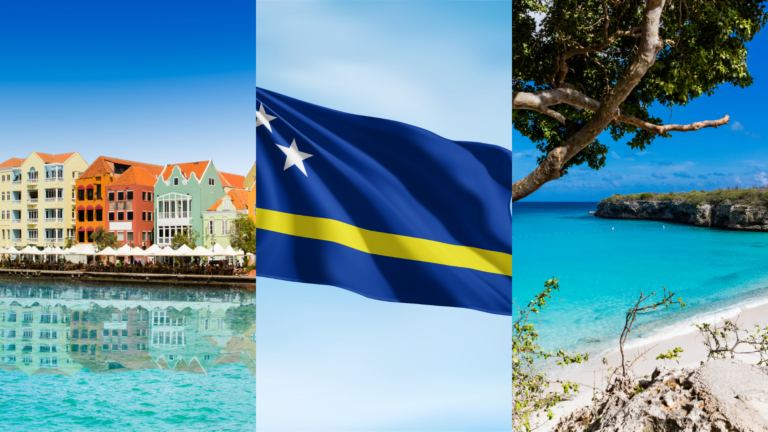
The Curaçao economy 2026 is defined by a combination that does not exist anywhere else in the Caribbean: Dutch institutional standards, a deep natural harbour connecting North America, South America, and Europe, a free trade zone serving over 30 million Caribbean consumers, and a multilingual workforce that moves between Papiamento, Dutch, English, and Spanish without friction. It is not a tourism destination that happens to have a business community. It is a serious regional hub that happens to have exceptional weather.
Located 60 kilometres off the coast of Venezuela, outside the primary Atlantic hurricane belt, Curaçao sits at the precise geographic intersection of the major trade routes linking the Americas. The island grew 5% in 2024, has a GDP per capita of approximately $22,833 — ranked 56th in the world — and operates as an autonomous constituent country of the Kingdom of the Netherlands under Dutch law. For international companies evaluating a Caribbean or Latin American hub, the Curaçao economy 2026 offers a specific combination of legal certainty, geographic position, and commercial infrastructure that no other island in the region can fully replicate.


Curaçao Economy 2026: Economic Outlook
The Curaçao economy 2026 is moderating from its post-pandemic peak but remains on a solid growth trajectory. The IMF’s 2025 Article IV mission confirmed that the economy expanded 5% in 2024, driven by strong stayover tourism performance that cascaded into construction, real estate, wholesale trade, and financial services. Growth is projected to moderate toward 2–3% over the medium term as tourism approaches infrastructure capacity — a projection that the IMF frames not as a warning but as a signal that the next phase of growth must come from diversification into port services, financial services, logistics, and digital business.
Curaçao’s constitutional position within the Kingdom of the Netherlands is its most underappreciated commercial asset. As an autonomous constituent country of the Kingdom — alongside the European Netherlands, Aruba, and Sint Maarten — Curaçao operates under Dutch law, Dutch institutional frameworks, and has direct constitutional links to the Kingdom’s legal system. The Central Bank of Curaçao and Sint Maarten, established in 1828, is the oldest central bank in the Caribbean. The Netherlands Antillean guilder (ANG) is pegged to the US dollar at a fixed rate of 1.79 ANG/USD — eliminating currency risk for dollar-denominated businesses and providing the same structural FX stability that has historically attracted international companies to Dutch-law jurisdictions. KLM operates direct flights between Amsterdam and Willemstad, with a flight time of approximately 9 hours, providing a direct air link to the European institutional network.
Inflation declined to 2.6% in 2024 from 3.5% in 2023, in line with global oil price movements and lower US inflation. The primary fiscal surplus continued its upward trajectory in 2024, driven by increased tax collection. The government is actively pursuing a VAT reform designed to be revenue-neutral and equity-enhancing, alongside digital infrastructure modernisation for the tax authority. For international companies, this combination of fiscal discipline, USD-pegged currency, Dutch legal framework, and improving regulatory infrastructure places Curaçao in a category distinct from most Caribbean jurisdictions.
“Curaçao’s economic activity expanded by 5 percent in 2024, as strong tourism performance trickled into the wider economy. Stayover arrivals, growing at double digits, continued to outperform Caribbean peers and carried over to other sectors, including wholesale trade, real estate, and construction.”
— IMF Article IV Mission Staff Concluding Statement · Curaçao · July 2025
Sectors with the Greatest Growth Potential

Transshipment Hub

Holding Structures

Hospitality

Free Trade Zone
Port and Transshipment Hub
The Port of Willemstad is built around the Schottegat — one of the finest natural deep-water harbours in the Western Hemisphere — and is the second largest seaport in the Kingdom of the Netherlands after Rotterdam. Its capacity exceeds 500,000 TEU annually and it can accommodate post-Panamax vessels, making it one of the few Caribbean ports with the physical infrastructure to serve as a genuine transshipment hub between North America, South America, and Europe. Located outside the primary hurricane belt, the port operates year-round without the seasonal disruption that affects many competing Caribbean ports. The Curaçao Ports Authority has been actively modernising the facility, and the port’s strategic position on major shipping routes between the Panama Canal and European destinations makes it a natural waypoint in any Latin American logistics network. For international shipping, freight forwarding, and port-adjacent logistics companies, the combination of natural harbour depth, Dutch operational standards, and geographic centrality creates a genuinely differentiated infrastructure proposition.
Financial Services and Holding Structures
Curaçao has a documented history as an international financial centre dating to World War II, when Dutch multinationals used the island as a safe haven for their financial operations. Today the island hosts international banks, captive insurance companies, trust companies, holding structures, and offshore financial institutions operating under a Dutch-law framework with its own financial regulator. The government’s ‘Open Arms’ policy actively targets technology companies and fintech firms alongside traditional financial services, offering a structured pathway for companies seeking a Caribbean jurisdiction with EU-level institutional credibility. The Dutch Caribbean Securities Exchange is located in Willemstad. For international companies evaluating a Caribbean financial services base, regional holding structure, or captive insurance arrangement, Curaçao’s combination of Dutch legal framework, USD-pegged currency, and 100-year track record in international finance is unmatched in the region.
Tourism and Hospitality
Tourism is Curaçao’s primary economic driver and its 2024 performance was exceptional: 700,249 stayover visitors and 834,922 cruise arrivals, generating an estimated $2.7 billion in total economic impact. Hato International Airport recorded 2.46 million passenger movements — a historic record. Willemstad’s UNESCO World Heritage designation (awarded 1997) for its Dutch colonial waterfront architecture, the island’s position outside the hurricane belt enabling year-round operations, and a scuba diving ecosystem ranked among the Caribbean’s best drive a visitor profile that skews toward higher-than-average spending. The IMF notes that tourism is approaching infrastructure capacity at current levels, which signals the next commercial opportunity: the technology, management systems, and hospitality expertise needed to improve yield per visitor rather than simply increase volume. For companies in property management technology, revenue optimisation, sustainable hospitality, and destination experiences, Curaçao’s growing, quality-oriented visitor base creates a well-funded buyer landscape.
Logistics and Free Trade Zone
Curaçao operates two free economic zones: the Curaçao Harbor Free Economic Zone, established in the late 1950s, and the Curaçao Airport Economic Zone adjacent to Hato International Airport. Both zones permit companies to import, store, repackage, present, and re-export goods without paying local duties, effectively operating as a bonded distribution platform for the Caribbean and Latin American markets. The Harbor Free Economic Zone is specifically positioned as a trading distribution centre serving over 30 million Caribbean consumers, with active merchants importing from Asia, the United States, and Europe for distribution across the region. For companies looking to establish a Caribbean distribution hub — consumer goods, electronics, industrial equipment, pharmaceuticals — the combination of the free zone framework, the deep-water port, and the Dutch customs administration infrastructure creates a logistics platform that reduces both cost and regulatory complexity compared with setting up distribution operations country-by-country across the Caribbean.
Trends Redefining the Curaçao Economy 2026
Three structural forces are reshaping the commercial landscape of the Curaçao economy 2026 in ways that create new entry opportunities for international companies beyond the island’s traditional tourism and financial services base.
The Isla Refinery Redevelopment: A Decade-Long Opportunity
The closure of the Isla Refinery in 2019 — once one of the largest in the world, with a 320,000 barrel per day capacity — left a significant industrial site at the Schottegat harbour available for redevelopment. The government has been evaluating alternative uses including LNG storage, industrial processing, and green energy infrastructure. The site’s direct deepwater harbour access, existing industrial infrastructure, and scale make it one of the most significant redevelopment opportunities in the Caribbean. For international companies in energy transition, industrial real estate, LNG logistics, or green energy infrastructure, the Isla site represents a once-in-a-generation opportunity to establish an industrial platform at the heart of one of the Caribbean’s premier natural harbours.
Digital Economy and the Open Arms Policy
The government’s ‘Open Arms’ investment policy has a specific and explicit focus on attracting technology and IT companies, reflecting a strategic ambition to diversify beyond tourism and traditional financial services into the digital economy. Curaçao’s multilingual workforce — Papiamento, Dutch, English, and Spanish — is a natural asset for companies building customer service, back-office, or technology operations serving the Caribbean, Latin American, and European markets simultaneously. The island’s political stability, Dutch legal framework, and USD-pegged currency reduce the operational risk profile for technology companies that in other Caribbean jurisdictions face currency volatility, regulatory uncertainty, or inadequate legal infrastructure.
Hurricane-Free Operations: The Structural Advantage Nobody Prices In
Curaçao’s location in the southern Caribbean — below the primary Atlantic hurricane track — is a structural operational advantage that receives almost no commercial attention. For companies with Caribbean operations, hurricane season (June–November) creates significant insurance costs, operational disruption risk, and supply chain uncertainty at competing locations. Curaçao is not immune to all tropical weather but its historical exposure to major hurricane damage is materially lower than most Caribbean islands north of its latitude. For data centres, distribution operations, financial services back-offices, and any operation where continuity of service is critical, this geographic advantage translates directly into lower insurance premiums, lower business continuity investment requirements, and more predictable operational planning.
Opportunities for International Companies
The Curaçao economy 2026 concentrates its commercial opportunity in Willemstad and the immediate port and airport zones. The city accounts for approximately 90% of the island’s population and all of its major commercial, financial, and logistical infrastructure. The Punda and Otrobanda districts — the UNESCO-listed historic waterfront — are the tourism and retail core. The Schottegat area hosts the port, free zone, and industrial facilities. The airport zone hosts the Airport Economic Zone business park with 24/7 security and direct airside access.
Entry mechanisms are Dutch-law based and well-understood by international legal practitioners. The standard vehicles are the N.V. (Naamloze Vennootschap — equivalent to a public limited company) and the B.V. (Besloten Vennootschap — equivalent to a private limited company), both familiar structures to European and international investors. Company registration is administered through the Curaçao Chamber of Commerce (KvK). The free economic zones offer duty-free import and storage with no local corporate tax on zone activities. The island has a network of tax treaties and its status within the Kingdom of the Netherlands provides access to treaty benefits that are not available to most Caribbean jurisdictions. For companies entering for financial services or holding structure purposes, professional trust and corporate services firms in Willemstad provide the local substance and administration required under current international tax standards.
Barriers to consider: Curaçao’s domestic market of approximately 156,000 people is small — any strategy based purely on local consumption has limited scale, and the commercial case depends on regional reach through the port, free zone, and financial services export model. Healthcare finances represent a structural fiscal challenge: annual deficits of the SVB healthcare fund amount to around 5% of GDP, creating medium-term fiscal pressure that the IMF has identified as an urgent priority. The labour market is relatively tight for specialised skills, and the island’s dependence on tourism creates some cyclicality in the wider economy. Finally, while the Dutch legal framework is a genuine advantage, navigating the specific local regulatory environment — particularly for financial services licensing — requires experienced local counsel familiar with both Dutch and Curaçaoan law.
Curaçao Economy 2026: Macroeconomic Outlook for Investors
The Central Bank of Curaçao and Sint Maarten (CBCS), established in 1828 and the oldest central bank in the Caribbean, manages monetary policy within a fixed exchange rate framework. The ANG has been pegged to the US dollar at 1.79 ANG/USD since 1971 — eliminating FX risk for dollar-denominated operations and providing the same structural monetary stability that has historically attracted international financial services companies to the island. Inflation at 2.6% in 2024 and projected to stabilise around 2.5% in 2026 is low by Caribbean standards and in line with the island’s primary trading partners. The fiscal primary surplus is on an upward trajectory, and the government is actively implementing tax system modernisation to broaden the revenue base in preparation for medium-term demographic and healthcare cost pressures.
For investors, the macroeconomic case for the Curaçao economy 2026 is built on stability rather than high growth: a USD-pegged currency with a 55-year track record, Dutch institutional governance, fiscal surpluses, and an economic base diversified across tourism, financial services, port operations, and logistics. Growth is moderating to a sustainable 2–3% range as the post-pandemic tourism surge normalises — but the structural diversification agenda, the Isla Refinery redevelopment pipeline, and the Open Arms digital economy initiative create medium-term upside that is not yet priced into the island’s international commercial profile. FDI inflows represent approximately 4.3% of GDP, reflecting steady but not yet peak international interest in what the island’s infrastructure and institutional framework can support.
Conclusions
The Curaçao economy 2026 is the Caribbean hub argument made concrete. A natural deep-water harbour that is the second largest port in the Kingdom of the Netherlands. A free trade zone serving 30 million Caribbean consumers. A Dutch law framework with a USD-pegged currency and the oldest central bank in the Caribbean. A geographic position outside the hurricane belt connecting North America, South America, and Europe. A UNESCO World Heritage capital generating $2.7 billion in annual tourism economic impact. And a multilingual workforce that operates in four languages across two continents.
The strategic question for companies evaluating the Curaçao economy 2026 is not whether the platform is real — it is. It is whether your sector — port-adjacent logistics, Caribbean distribution, financial services, hospitality, or digital operations — maps onto the specific infrastructure and institutional advantages that Curaçao offers. For companies that have been building Caribbean or Latin American strategies country-by-country and are now evaluating whether a hub model would be more efficient, Curaçao in 2026 is the most credible answer the region has to offer.
Thinking about entering the Curaçao market?
Gedeth Network helps international companies analyse, plan and execute their expansion into Curaçao — from market entry strategy to free zone registration and local partner identification.
Talk to our team