
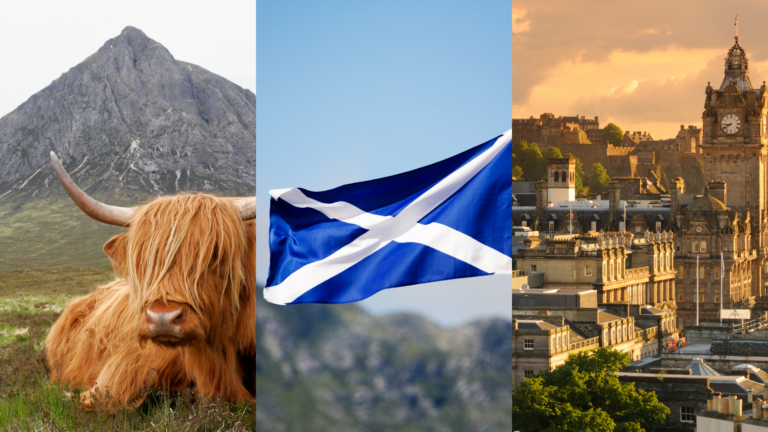
The Scotland economy 2026 is doing something that very few European economies can claim: generating more electricity from renewables than it consumes, hosting the largest pipeline of offshore wind development on the continent, and simultaneously running a technology startup ecosystem that has produced global companies like Xero and Rocket Lab. The energy transition is not a future ambition for Scotland — it is an operational reality, and it is creating a specific, decade-long procurement pipeline for international companies with the right offering.
Scotland grew 1.4% in 2025 — outperforming the UK average of 1.3% and above France and Germany. KPMG projects 1.2% growth for 2026, keeping pace with the UK and ahead of the Eurozone average. EY reported that in 2024, Scotland attracted approximately 16% of all foreign direct investment into the UK, with 25% of global investors planning to establish UK operations expecting to choose Scotland — making it the top FDI destination in the UK outside London for over a decade. The Scotland economy 2026 is also hosting the Commonwealth Games in Glasgow — the largest international sporting event on Scottish soil in decades — placing Scotland on the global stage at exactly the moment its energy transition investment pipeline is accelerating. Aberdeen secured £10 billion in green energy investment commitments at the Edinburgh Global Investment Summit in 2025. The window is open.


Scotland Economy 2026: GDP Growth and Economic Outlook
The Scotland economy 2026 is growing steadily within the UK framework. Scotland’s onshore GDP grew 1.4% in 2025, strengthening from 1.1% in 2024 and 0.7% in 2023 — a consistent upward trajectory that reflects the services sector’s resilience (growing 2.0% in 2025) and the construction sector’s recovery (+1.3%). KPMG projects 1.2% growth in 2026, ahead of France and Germany, and in line with the UK as a whole. The broader economic environment presents genuine challenges: manufacturing contracted 4.0% in 2025 following the Grangemouth refinery closure and the impact of US tariffs on goods exports, business investment confidence declined through Q1 2026, and 18.5% of Scottish businesses reported rising energy cost concerns — the highest share since late 2022.
The structural story, however, runs in the opposite direction to the cyclical headwinds. Scotland’s economy generated 113% of its electricity consumption from renewables in 2025 — meaning it exported clean power to the rest of the UK on a net basis. The ScotWind leasing round allocated licences for 27.6GW of new offshore wind capacity, three-quarters of which is located within 100 nautical miles of Aberdeen. The INTOG (Innovation and Targeted Oil and Gas) round added a further 5.5GW specifically for offshore installations decarbonising North Sea operations. Scotland’s total energy pipeline could exceed 50GW. These are not planning permissions — they are awarded licences with committed developers, representing a £50+ billion investment pipeline running through 2035.
Scotland operates within the United Kingdom’s constitutional and legal framework, with English common law applying throughout Great Britain and Scotland’s own Scottish law operating in parallel for specific matters. For international companies, this means access to the UK single market (population 68 million), UK trade agreements, and UK financial regulation — combined with the Scottish Government’s specific investment incentives, enterprise support through Scottish Enterprise and Scottish Development International, and direct engagement with Scottish Ministers and the First Minister on major investment decisions. The Scottish Government’s Programme for Government 2025–2026 explicitly identifies technology and innovation as sectors where it will “nurture and expand” Scotland’s international reputation, and has committed to additional investment in food and drink, screen, and renewable energy to support the energy transition.
“Scotland’s economy grew 1.4% in 2025, strengthening from 1.1% in 2024. Growth was predominantly driven by the services sector (2.0%) and the construction sector (1.3%). Scotland’s natural capital accounts for around £40 billion of economic output and approximately 260,000 full-time equivalent jobs.”
— Scottish Government · Scottish Economic Insights · March 2026
Sectors with the Greatest Growth Potential

Energy Transition

CCUS

Life Sciences

Tourism
Offshore Wind and Energy Transition Supply Chain
Scotland’s offshore wind opportunity is the largest concentrated renewable energy investment pipeline in Europe. The ScotWind programme allocated 27.6GW of new capacity — including both fixed and floating projects — with major developers including SSE Renewables, Equinor, BP, Shell, TotalEnergies, and Vattenfall holding licences. The world’s first commercial-scale floating offshore wind project, Green Volt, is under development off the Scottish coast. The Pentland Offshore Wind Farm, currently under construction, will be the world’s largest floating wind farm when completed. Aberdeen’s Energy Transition Zone (ETZ) — a 250-hectare purpose-built net zero site adjacent to the newly completed £420 million South Harbour — is specifically designed to house the manufacturing, assembly, and operations infrastructure for this pipeline. For international companies in wind turbine components, subsea cables, installation vessels, operations and maintenance, and offshore engineering services, the Scottish pipeline provides visibility of demand through 2035 that is backed by awarded licences and committed developers.
Green Hydrogen and Carbon Capture
Scotland is targeting 5GW of installed hydrogen production capacity by 2030 and 25GW by 2045. The Kintore Hydrogen project is Europe’s largest green hydrogen production facility. Aberdeen operates the world’s first hydrogen-powered double decker bus fleet and hosts 85 hydrogen vehicles across the city — one of the largest and most varied fleets in Europe. The Scottish Government is in Phase 2 of a project examining an offshore pipeline from northeast Scotland to Germany, connecting to the European Hydrogen Backbone — which, if developed, would position Scotland as a direct green energy exporter to continental Europe. Scotland’s North Sea depleted oil and gas reservoirs provide exceptional carbon storage capacity, making it one of the most viable locations in Europe for Carbon Capture, Utilisation and Storage (CCUS) at scale. For companies in electrolyser manufacturing, hydrogen infrastructure, carbon capture technology, and pipeline engineering, Scotland combines natural resource endowment, infrastructure foundations, and government commitment in a way that is unique in the UK.
Technology, Fintech, and Life Sciences
Edinburgh and Glasgow together form one of the UK’s most dynamic technology ecosystems outside London. Scotland hosts over 227 fintech companies, employing around 11,300 professionals across RegTech, AI solutions, and blockchain, and has attracted over 55 international fintechs since 2021. Edinburgh’s GDP per capita has surpassed London by some measures, reflecting the concentration of financial services, technology, and professional services employment in the city. Scotland produces over 95,000 graduates annually from its 19 universities, including the University of Edinburgh, University of Glasgow, and Heriot-Watt University — institutions with globally recognised research strength in AI, data science, quantum computing, and life sciences. With annual exports of over £4.4 billion, Scotland’s chemical sciences sector is ranked among the world’s top three locations for chemical sciences R&D, hosting major players including FUJIFILM, GSK, Dow, and Syngenta. AI adoption among Scottish businesses is accelerating, with the Information and Communication sector reporting 60.9% AI adoption — the highest share of any sector in Scotland.
Commonwealth Games 2026 and Tourism
Glasgow hosts the 2026 Commonwealth Games — the largest international multi-sport event on Scottish soil since the 2014 Commonwealth Games, which generated an estimated £740 million in economic impact. The 2026 Games will bring athletes from 72 nations and territories and a global broadcast audience, placing Scotland’s cities, landscapes, and commercial environment in front of an international audience at exactly the moment the energy transition investment pipeline is accelerating. The Scottish Government has committed additional funding to VisitScotland and is working with airlines and travel partners to extend seasonal routes and improve international connectivity. Tourism directly supports approximately 15,000 businesses and contributes significantly to Scotland’s services sector GDP. For companies in hospitality technology, sustainable tourism infrastructure, event management, and destination services, the Commonwealth Games creates both immediate commercial demand and a platform for longer-term brand positioning in one of Europe’s most visited destinations.
Trends Redefining the Scotland Economy 2026
Three structural forces are creating specific commercial openings in the Scotland economy 2026 that did not exist in the same form two years ago.
Aberdeen’s Transformation: Oil Capital Becoming Energy Transition Capital
Aberdeen has been Europe’s oil and gas capital for fifty years. The skills, supply chain companies, offshore engineering expertise, and port infrastructure built for the North Sea are now being systematically redeployed into offshore wind, green hydrogen, and CCUS. The Aberdeen showcase in early 2026 connected investors with specific projects and technologies, with Scottish Financial Enterprise and ETZ Ltd partnering to present opportunities across offshore wind, green hydrogen, carbon capture, and decommissioning. The £420 million South Harbour, completed in 2023 as the UK’s largest marine infrastructure project, is purpose-built to handle the logistics of the offshore wind supply chain. For international companies with offshore engineering capability, the Aberdeen ecosystem is not a market to enter from scratch — it is a market to plug into, where established relationships, shared infrastructure, and a workforce with directly transferable skills create a faster path to operational presence than almost any comparable energy hub in Europe.
£10 Billion Green Investment Commitment
Scotland secured £10 billion in green energy investment commitments at the Edinburgh Global Investment Summit in 2025, with the event bringing together institutional investors, project developers, and energy companies to discuss financing structures and risk mitigation for Scotland’s energy transition pipeline. This level of committed capital — not announced intentions, but structured investment commitments — de-risks the supply chain opportunity for companies evaluating whether the project pipeline is real. Combined with the ScotWind licences, the Aberdeen ETZ infrastructure, and the Scottish Government’s active support through Scottish Enterprise, the investment environment for the Scotland economy 2026 energy transition is the most structured and de-risked it has ever been.
Space and Aerospace: The £4 Billion Industry by 2030
Scotland is on track to build a £4 billion space industry by 2030, including launch capability, satellite production, and downstream data services, with global players like Spire, Chevron, and Celestia already invested. The Sutherland Spaceport in the Scottish Highlands is the first vertical launch facility in the UK and one of the first in Europe. Prestwick Airport in Ayrshire is a designated UK Space Gateway. Scotland’s deep engineering legacy, university research infrastructure, and data analytics capability create a natural foundation for a space supply chain that is currently in the early-mover phase — where international companies with satellite technology, launch services, and downstream data analytics find the market less crowded and the institutional support more direct than at comparable hubs.
Opportunities for International Companies
Scotland’s commercial geography organises around three cities. Edinburgh is the financial, professional services, and technology hub — home to the financial sector, the startup ecosystem, government institutions, and the majority of Scotland’s tech companies. Glasgow is the industrial, engineering, manufacturing, and events hub — Scotland’s largest city by population, home to the Commonwealth Games, the University of Glasgow, and a regenerating industrial base. Aberdeen is the energy hub — the base for offshore oil and gas, the Energy Transition Zone, and the ScotWind supply chain cluster that will define Scotland’s commercial landscape for the next two decades.
Entry into Scotland is operationally identical to entry into the rest of the UK. Companies register a limited company with Companies House (typically same-day online), operate under English and Scots law with full UK single market access, and benefit from Scottish Enterprise and Scottish Development International’s active inward investment support — including grant funding, talent acquisition support, and direct matchmaking with Scottish supply chain partners. The UK’s corporate tax rate of 25% applies, with R&D tax credits of up to 27% for qualifying innovation investment particularly relevant for technology and energy companies. Scotland’s lower commercial property costs relative to London and lower average wages than the Southeast of England make it cost-competitive for establishing UK operations, while its talent pool from 19 universities ensures skilled workforce availability in key growth sectors.
Barriers to consider: Scotland’s constitutional status within the UK creates a layer of political uncertainty that international companies must factor into long-term planning: the Scottish National Party’s independence agenda, while not an immediate risk given the absence of a confirmed referendum, affects investor confidence in certain sectors and creates regulatory uncertainty around potential future divergence from UK frameworks. Manufacturing contracted 4.0% in 2025, reflecting genuine weakness in the production sector that limits opportunities in that specific area. Energy costs remain elevated for industrial users and are a growing concern for Scottish businesses. Grid connection queues for new renewable energy projects remain a significant operational bottleneck that affects project timelines for energy sector entrants. None of these barriers are prohibitive for a well-structured entry, but they require specific planning from day one.
Scotland Economy 2026: Macroeconomic Outlook for Investors
Scotland operates within the UK’s monetary and fiscal framework. The Bank of England’s Monetary Policy Committee sets interest rates for the whole of the UK, with the base rate currently on a gradual easing trajectory following the 2022–2023 tightening cycle. UK inflation has returned closer to the 2% target, supporting a continued modest easing path through 2026. Scotland’s fiscal position is determined by a combination of the Barnett Formula block grant from the UK Government and devolved tax revenues — including Scottish Income Tax, which the Scottish Parliament sets independently. The Scottish Government faces fiscal pressure in 2026 from a squeeze in grant funding available from the UK Government, which KPMG identifies as a potential drag on public sector growth over the medium term.
For investors, the macroeconomic case for the Scotland economy 2026 combines UK-level monetary stability and legal certainty with Scotland-specific sector advantages in energy, technology, and life sciences that are not replicated elsewhere in the UK at the same scale. The £10 billion green investment commitment, the 27.6GW ScotWind pipeline, the Aberdeen Energy Transition Zone, and the Commonwealth Games tourism platform all represent funded, operational opportunities rather than aspirational targets. KPMG’s assessment that Scotland will outperform France and Germany in 2026 is supported by the structural composition of its growth — services-led, investment-backed, and increasingly anchored in the energy transition sectors that global capital is actively seeking.
Conclusions
The Scotland economy 2026 is the energy transition capital of Europe by any objective measure of pipeline, infrastructure, and committed investment. 113% renewable electricity generation. 27.6GW of awarded offshore wind licences. £10 billion in secured green investment commitments. The world’s first commercial-scale floating offshore wind project. Europe’s largest green hydrogen production facility at Kintore. A 250-hectare Energy Transition Zone in Aberdeen purpose-built for the supply chain. A space industry on track for £4 billion by 2030. A fintech ecosystem of 227 companies. And the 2026 Commonwealth Games providing global visibility at exactly the right moment.
The strategic question for companies evaluating the Scotland economy 2026 is whether their offering — in offshore wind, green hydrogen, CCUS, space technology, fintech, or life sciences — maps onto the specific procurement pipelines that are funded and active today. For companies that answer yes, Scotland in 2026 offers early-mover positioning in Europe’s most concentrated clean energy supply chain, backed by a decade of awarded licences, committed developers, and institutional support that makes the path from market assessment to operational presence faster than at any comparable location on the continent.
Thinking about entering the Scottish market?
Gedeth Network helps international companies analyse, plan and execute their expansion into Scotland — from energy transition supply chain entry to technology sector market assessment and commercial launch.
Talk to our team