
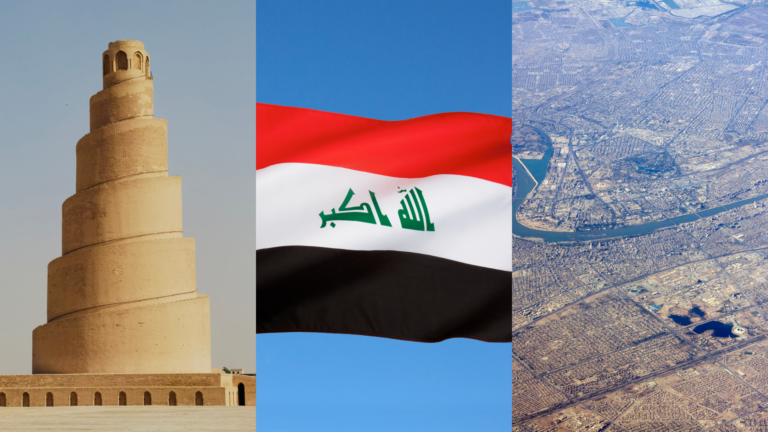
The Iraq economy 2026 requires the same clarity we brought to Haiti and Jordan: the headline numbers are difficult, the structural opportunities are real, and the companies best positioned to engage are those that can distinguish between the two. The IMF projects GDP contraction of -6.8% in 2026 — driven primarily by OPEC+ production limits constraining oil output and the Strait of Hormuz disruptions reducing export capacity — not by a collapse of Iraq’s institutional or economic foundations. Beneath that headline, the World Bank has committed $2.24 billion across ten active projects, TotalEnergies launched its $10 billion Gas Growth Integrated Project with first production online in early 2026, the UK signed a $12 billion trade deal with Iraq in January 2025, and a $930 million World Bank railway project was approved in 2025 alongside a $900 million road connectivity project in June 2026.
Iraq is the fourth-largest economy among Arab countries and holds the world’s fifth-largest proven oil reserves. Its population of 46.6 million is young, growing, and concentrated in cities that require housing, services, energy, and connectivity that the public sector alone cannot provide. The Iraq economy 2026 is not a market for companies seeking stability comparable to Jordan or a legal framework comparable to Scotland. It is a market for companies with specific sector expertise, the operational experience to function in complex environments, and the medium-term horizon to participate in one of the largest reconstruction and diversification programmes in the Middle East. For the right company, the entry window is now.


* Driven primarily by OPEC+ production constraints and Strait of Hormuz export disruptions — not structural economic collapse. IMF pre-conflict projection was +3.6% growth for 2026.
Iraq Economy 2026: Economic Outlook — The Full Picture
The Iraq economy 2026 is experiencing a sharp cyclical contraction that requires careful reading. The IMF’s April 2026 World Economic Outlook projects -6.8% real GDP growth — the steepest contraction in recent years — driven by two specific and measurable factors: OPEC+ production quotas constraining Iraq’s oil output by approximately 5.7% year-on-year, and the blockade of the Strait of Hormuz through which most of Iraq’s oil exports transit, which has significantly reduced both export capacity and production incentives. This is not a generalised economic crisis — it is the concentrated impact of external constraints on an economy that is 88% dependent on oil revenues. Non-oil GDP grew 1.5% in the same period, confirming that the non-hydrocarbon economy continues to expand even as the headline contracts.
The pre-conflict IMF projection for 2026, published in October 2025 before the full impact of the Strait of Hormuz disruptions was priced in, was +3.6% growth — with acceleration to 3.9% in 2028 and 4.1% by 2030. The World Bank projects oil GDP growing 5.1% in 2026–2027 once OPEC+ constraints ease, reinforcing the view that the current contraction is cyclical rather than structural. Iraq is projected to have the fourth-largest economy among Arab countries by 2030, with a GDP of $345.9 billion. For companies evaluating a medium-term commitment, the trajectory matters more than the 2026 headline — and the trajectory is upward once the external constraints resolve.
Iraq’s structural economic challenges are real and must be part of any honest assessment. Oil accounts for 88% of government revenues and 91% of merchandise exports — a dependency that leaves the budget highly vulnerable to price shocks and production constraints. Governance and corruption remain significant obstacles: Iraq ranks 172 out of 190 countries on the World Bank’s Ease of Doing Business Index. Infrastructure deficits are pervasive — water scarcity, electricity shortages, and inadequate transport networks create genuine operational complexity. And the political landscape — including the ongoing tensions between Baghdad and the Kurdistan Regional Government over budget allocations — adds a layer of institutional friction that affects decision timelines and contract enforcement. These are not reasons to avoid Iraq. They are the risk framework within which the opportunity must be structured.
“Iraq must seize the economic opportunity offered by the country’s young and dynamic population. The government has prioritized rebuilding infrastructure, improving public services, and fostering economic reforms, with support from international partnerships to foster sustainable development and strengthen human capital.”
— World Bank · Iraq Country Overview · 2026
Sectors Where Engagement Is Viable in 2026

Energy Services

Transport

Power Generation

Food Security
Oil, Gas, and Energy Services
Iraq’s energy sector remains the primary commercial entry point for international companies — not because alternatives do not exist, but because the scale of activity, the concentration of international operators, and the established contracting frameworks make it the most structured environment in the country for foreign business. TotalEnergies’ $10 billion Gas Growth Integrated Project (GGIP) reached first production in early 2026, processing associated gas from oil fields in southern Iraq that was previously flared — producing electricity for 1.5 million Iraqi households and marking a significant milestone in Iraq’s gas flaring reduction programme. The project employs 7,000 Iraqi nationals during construction. ExxonMobil, BP, Shell, Lukoil, and China National Petroleum Corporation (CNPC) all maintain active upstream operations. Gas field development to reduce Iraq’s dependence on Iranian gas imports is identified as one of the most promising opportunities for 2026, with natural gas projects progressing across nearly every oil field in the country. For international companies in oil field services, gas processing technology, pipeline engineering, seawater treatment, and energy project management, the Iraqi upstream sector provides a documented and active procurement pipeline backed by international oil company partners with established contracting processes.
Infrastructure and Transport
Iraq’s infrastructure deficit is simultaneously its greatest challenge and its most visible commercial opportunity. The World Bank approved a $930 million Iraq Railways Extension and Modernisation Project in 2025, and a $900 million road connectivity project in June 2026 — together representing $1.83 billion in World Bank-backed transport investment in under twelve months. The Grand Faw Port project in Basra — one of the largest port development projects in the Middle East — aims to create the largest port on the Persian Gulf, with capacity to handle 99 million tonnes annually and serving as a regional logistics hub connecting Asia, Europe, and Africa. The government has allocated $100 billion to its investment budget and is providing sovereign guarantees to the private sector for qualifying projects. The UK–Iraq Partnership and Cooperation Agreement, signed in January 2025 and covering a trade deal of more than $12 billion, specifically identified construction, energy, and infrastructure as priority sectors for British firms. For international companies in engineering, construction, project management, logistics, and infrastructure technology, Iraq’s transport and connectivity pipeline is one of the largest in the Arab world.
Solar Energy and Power Generation
Iraq faces a chronic electricity deficit: despite near-universal grid connection, power outages average 8–12 hours daily in many urban areas, and the government imports electricity from neighbouring countries to cover the gap. This creates a direct and urgent procurement demand for power generation capacity. Utility-scale solar farms are identified by the UNDP’s Iraq SDG Investor Map as one of the top investment opportunity areas, given Iraq’s exceptional solar irradiation levels — among the highest in the world for desert-climate solar PV generation. TotalEnergies’ GGIP includes a solar component alongside the gas processing facilities, establishing a reference model for integrated clean energy projects in the country. The government has stated ambitions to reach 12GW of renewable energy capacity by 2030. For companies in solar EPC, independent power producer (IPP) structures, battery storage, and grid modernisation, Iraq’s power generation gap combined with its solar resource creates a commercially real demand that is not dependent on oil price cycles.
Agriculture and Food Security
Iraq’s agricultural potential is historically significant — the Tigris and Euphrates river system is one of the oldest agricultural civilisations in human history — but the sector today contributes less than 4% of GDP and is severely constrained by water scarcity, outdated infrastructure, and competition from imports. Climate change, reduced rainfall, and upstream dams in neighbouring countries have intensified water shortages. The government has sought international cooperation on water-sharing and sustainable agriculture, and the World Bank’s active portfolio includes water and municipalities projects. The UNDP’s SDG Investor Map identifies food processing, mid-tech greenhouses, and specialty dairy as viable private sector investment opportunity areas. For companies in agricultural technology, precision irrigation, food processing, cold chain logistics, and greenhouse construction, Iraq’s food import dependency — it imports a significant share of its food requirements — creates a structural commercial gap that will need to be addressed regardless of oil price cycles.
Trends Redefining the Iraq Economy 2026
Three developments in 2026 are materially changing the commercial landscape for international companies evaluating Iraq — all of them independent of the OPEC+ constraints driving the headline GDP contraction.
The UK–Iraq Partnership: A New Western Commercial Framework
In January 2025, Iraq’s Prime Minister met with UK business leaders and signed a Partnership and Cooperation Agreement covering more than $12 billion in trade and a range of export agreements. The agreement includes commitments across telecommunications (Vodafone was authorised to launch Iraq’s first 5G network in late 2024), construction, petrochemicals, and energy. In 2024 alone, the UK participated in $1.5 billion worth of projects in Iraq. This bilateral framework matters because it signals a deliberate Iraqi government strategy to diversify its international commercial relationships beyond the traditional US and Chinese investment models — and it creates structured pathways for European and Ibero-American companies to enter through UK-anchored consortia and partnerships that benefit from the diplomatic and commercial credibility of the bilateral agreement.
China’s Infrastructure Presence: The Contracting Context
China has invested over $10 billion in Iraq through the Belt and Road Initiative since 2015, making Iraq the fourth-largest BRI recipient globally. Chinese state-owned enterprises dominate large-scale infrastructure contracts, and Iraq’s oil-for-infrastructure agreements with China cover schools (1,000 schools framework agreement), housing, and transport. For international companies, understanding China’s dominant position is essential context: the most viable entry strategies are either in sectors where Chinese presence is limited (gas processing technology, solar EPC, agricultural technology, specialist services) or in roles that complement rather than compete with Chinese infrastructure delivery — such as project management, quality assurance, technology licensing, and operations and maintenance.
Iraq Vision 2030 and Economic Diversification
Iraq’s National Development Plan and Vision 2030 identify economic diversification away from oil dependency as a generational priority. The government has carried out reforms in taxation, customs, and company registration, and has committed sovereign guarantees to private sector investment. Customs revenue doubled in 2024 to IQD 2.1 trillion. Banking system reforms are gradually improving financial infrastructure. And the country’s young population — with youth aged 15–29 representing nearly 29% of the total — creates a structural long-term consumer and labour market that will need private sector development to absorb. For companies entering Iraq today, the Vision 2030 framework provides a documented and officially endorsed rationale for diversification investment that helps navigate government procurement and partnership structures.
The Risk Framework: Managed Honestly
Any company considering engagement with the Iraq economy 2026 must operate within a clear-eyed risk framework. Security conditions vary significantly by region: the Kurdistan Region in the north (Erbil, Sulaymaniyah) operates a more stable and investor-friendly environment than Baghdad or southern governorates, and many international companies choose it as their operational base for Iraq-wide activities. Corruption is pervasive and due diligence on local partners, government officials, and procurement processes is non-negotiable — not optional. Contract enforcement through Iraqi courts is slow and unreliable, making international arbitration clauses in all agreements essential. The political dynamic between Baghdad and the KRG affects budget transfers, investment approvals, and regulatory interpretations in ways that require experienced local legal counsel to navigate. And the macroeconomic environment — with 88% of government revenues dependent on oil prices set by external actors — means that government payment timelines for public contracts can be affected by oil revenue fluctuations that have nothing to do with project performance.
The companies best positioned for Iraq are those operating within multilateral frameworks (World Bank, IFC, UNDP procurement), those entering as subcontractors or technology partners to established international oil companies with existing contracts, those working through the UK–Iraq PCA bilateral structure, or those with prior fragile-state and emerging market operating experience who have built the internal compliance, security, and partnership frameworks required. Political risk insurance through MIGA or equivalent providers is not optional for significant capital commitments — it is a baseline requirement.
Entry structure recommendations: Establish operational base in Erbil (Kurdistan Region) for lower security risk and more business-friendly regulatory environment. Structure all contracts with international arbitration clauses (ICSID or ICC). Engage Iraqi legal counsel with both Baghdad and KRG experience from day one. Require MIGA or equivalent political risk insurance for capital investments above $5 million. Prioritise entry through existing IOC partnerships, World Bank project pipelines, or bilateral UK–Iraq framework rather than standalone government procurement. Build a local Iraqi partner relationship with documented B-BBEE-equivalent governance standards and anti-corruption compliance from the outset.
Iraq Economy 2026: Macroeconomic Outlook for Investors
Iraq’s fiscal position in 2026 is under pressure from the combination of OPEC+ constraints reducing oil production volumes and the Strait of Hormuz disruptions affecting export revenues. The government’s 2025 budget was based on an oil price assumption of $70 per barrel — and with prices fluctuating below that level and production constrained, the fiscal deficit is widening. Public debt is projected to rise toward 59.5% of GDP by 2027 without fiscal reforms. International reserves, while currently adequate, are declining from their 2022–2023 peaks as the current account moves into deficit.
For investors, the medium-term picture is more constructive. The World Bank projects non-oil GDP growing consistently, oil GDP recovering as OPEC+ constraints ease and the Strait of Hormuz situation stabilises, and the IMF’s pre-conflict baseline of 3.6% growth by 2026–2027 remaining achievable. Iraq’s fourth-largest Arab economy status by 2030 is a GDP projection of $345.9 billion — a market of genuine scale. The Iraqi dinar has been stabilised following the 2023 exchange rate corrections and subsequent interventions. For companies entering through project-based structures with revenues denominated in USD (standard in oil sector and World Bank-funded projects), the currency risk is manageable.
Conclusions
The Iraq economy 2026 is not a market for every company. The -6.8% GDP contraction, the governance challenges, the infrastructure deficits, and the political complexity create a risk profile that is genuinely high and must be genuinely managed. But it is also not a market to dismiss based on the headline. The fifth-largest oil reserves in the world. $1.83 billion in World Bank transport investment approved in twelve months. A $10 billion TotalEnergies gas project with first production in 2026. A $12 billion UK trade deal. A 5G network launch. A 46.6 million person market projected to be the Arab world’s fourth-largest economy by 2030. And a government that has doubled its customs revenues, provided sovereign guarantees to private investors, and allocated $100 billion to its investment budget.
The strategic question for companies evaluating the Iraq economy 2026 is not whether Iraq has opportunities — it does, and they are large. It is whether your company has the sector expertise, the operational experience, the risk tolerance, and the long-term horizon to engage with them properly. For companies that can answer yes to all four, Iraq in 2026 offers early-mover positioning in one of the most significant reconstruction and diversification programmes in the Middle East — at a moment when the competition for that position is thinner than the scale of the opportunity suggests it should be.
Want to understand Iraq before deciding?
Before any market entry decision in a complex market like Iraq, the right question is whether the opportunity matches your company’s specific profile, risk tolerance, and operational experience. Gedeth Network offers an Iraq market intelligence briefing — covering sector fit, entry structure, risk framework, and current investor activity — so you can make an informed decision with the full picture.
Request a Briefing